Speaker for the Gods, week 21
War on the Windward Fields, part 1
We marched, the five of us, through burned cane stalks amidst a blanket of ashes soft as snow. Sunlight beat down on the blackened ground, throwing off a terrific glare that forced me to shield my eyes. Between the Sun and the smoldering Earth, we were smothered by murderous heat. Breezes did little to break it up, expending their efforts on torrid little cyclones of ash. Cinders had blown across the road in spots; the three Kane winced and hopped over them. I exchanged a smile with Staves, the both of us safe in our boots.
Pressing on, we came to a place where bodies lay by the hundreds. Red and white banners stood where they’d been planted, anchored in place by the weight of dead flesh. Neither they nor the corpses showed much fire damage—the To’means had burned these fields days before, and still they smoked. The smell defied description; Ke’iwa retched on the roadside and even Staves covered his nose and mouth. I could see no pattern in the fallen, no signs as to their lines or tactics. It must have been open war on this plain, men butchering each other over waste: no birds, no living people, nothing but screams and violence and now death. For the first time since I came to the islands, nature stood silent as a tomb.
“We gonna run smack into ‘em. Should get off da road,” Ke’iwa noted in English rougher and less formal than Ienith’s. “And what good would that do?” chirped Staves, saving Ienith the response. “D’you see anything to hide us?” he swiveled his head back and forth for effect. Indeed there was nothing, just piles of eroded ash-blanketed rocks from old lava flows.
Ke’iwa clammed up and Ienith smirked to see her brother embarrassed. “But seriously, m’Lady,” Staves continued, “you got a plan for that? We start fighting miles from the city and we’ll never reach it.”
“Five can avoid notice better than Keone’s nui kaua. We’ll see them first. And the Io’s scroll said war loomed in the fields. So we take our time, creep up slowly and hope to rush by when the two sides meet,” She declared, jaw confidently set.
“What happens if we’re spotted sneaking past?” I asked.
“Then I’ll need the next idea,” Ienith stuck out her tongue and reached out to pat the back of my neck. For a spell I couldn’t quit smiling.
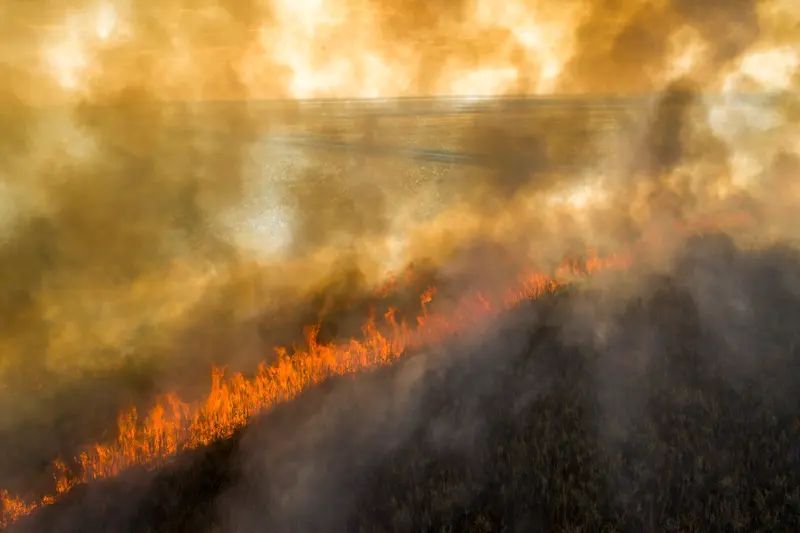
Cane fields ended at last, replaced by the cornfields I’d spied from the distant pumping station. They were only recently put to the torch and white smoke still rose from cauterized stalks. Fires still raged close to the hills, roaring thirty feet in the air. The bodies in the fields were burned beyond recognition—they’d fallen before the corn burned. The air smelled of burned flesh rather than rotting, struck through with notes of acrid smoke and the musty damp of coming rain.
We kept a deliberate pace along the road, sipping our water skins to counter the ash drying our mouths. Nobody spoke in the fog of smoke and ghosts around us that cut off all view of the hills to our west, the distant sea downhill to our east, the lush coastal forest to our south. The place hardly seemed real, like we walked through some plane of the afterlife. I thought back to the beach with the birds flying furious loops around me, turning the world into a rushing dreamscape. From light and love and flying feathers to flames and fear and swirling smoke in just three days’ time.
Kapono stopped abruptly some miles on near a heap of seared rocks. Wiping off the ash with his hands, he leaned in and put his ear against the bare stones. “Hai’oleo,” he solemnly stated with eyelids screwed shut. “Many voices, some further than others. None too far.” Kapono opened his eyes and rose, tightening his pack’s shoulder straps.
“Did Keone Speak?” Ienith demanded.
“I can’t be sure. There were calls and responses, going two directions.”
“Issuing challenges,” the High Speaker said with a nod. “Keone flaunts his power. The Speakerage will know it, at least.”
“There’d be no reason to hide his cards. Not now,” I opined.
“Cards. Cards,” Ke’iwa said, turning his mouth over the alien English sounds. “What are cards?”
“It doesn’t matter, kunane.” Ienith secured her bow over her shoulder and unhooked her quiver to cradle it in her elbow.
“Getting on, at last!” Staves announced, and took off at a jog as we followed. I labored hardest, gritting my teeth as my leg throbbed.
It wasn’t long before we heard voices from the north. With rain imminent I might’ve taken the sounds for thunder, but recent experience taught me otherwise. Broken up by the wide-open plains, sound rolled in waves over our heads and stirred the ceiling of clouds. I heard many softer voices repulsed by a throaty force majeure—what I took for Keone’s voice. Dead cornstalks bounced by in time with my strides.
We stopped to rest by what had been a banana orchard, its denizens hacked to pieces and their fruit stripped. The conquerors had spared them the torch, but the huts huddling in a nearby cluster were charred husks. We passed through, stopping short of the tree line to peer between the naked trunks. A quarter-mile ahead, two armies lay assembled.
Thousands of men opposed each other across a gap, the forces molded into two distinct lines but each too rowdy for proper ranks. Warriors brandished their weapons and screamed awful things at one another under hai’oleo’s crashing din. Red banners waved from the long slow upward slope to the north, which stretched away to the distant and unseen capitol. Much closer, white flags whipped in the sorcerous wind. They were positioned at a crossroads between the main road and another east-west path, Keone occupying the nexus and the To’means blocking his way north. To the east, emerald farmland twinkled whole and healthy near the distant blue sea. To the west, a larger throughway hit the Kuamo’o foothills and switchbacked up them: the very same path Friar Waldman trod decades before. Though magic brewed up the clouds above us, I couldn’t gauge its purpose.
“What are they waiting for? Is all that booming for show?” I asked Ienith.
“Years ago, speeches came before battle. Terms offered, honors exchanged, histories read, heroes selected to duel. This is none of that,” she clarified, glancing up at me. “So yes, mostly for show. Boys waving their ule around.”
I fought back a giggle. “Keone’s is the loudest voice.”
She nodded. “Three High Speakers. Hali’a Ho’opi’i. Kaweo Ku’kamalu. I can’t tell the third.”
“It’s really that specific?”
“Voices are voices,” she shrugged. “You know mine. I know yours.”
Ke’iwa interrupted with a stream of Kane so profane I couldn’t translate. He saw the general; he saw Keone. Following his pointed finger, I picked out the man he meant and felt stupid for not seeing him earlier. Tall, lean and graceful, he stood out like a fine hound even at two hundred yards. He sat astride a grey horse: the first I’d seen on To’mea and the only one in his army. Every king has his vanities. Man and beast alike wore white with black highlights, and the conqueror wore the typical crested helm of the most exalted Kane. Gold feathers clung to a basket frame, providing massive size with minimal weight. Keone was unarmed with palms held out to either side, hurling pronouncements of doom into the sky.
“Just shoot him,” Staves suggested to Ienith. “Magic up one of those arrows and put it through his bonnet.” She rolled her eyes in response.
Spells fell silent in the skies at last, trickling out after one last gout of fury. Hai’oleo washed out over roasted plains, leaving in its wake the chants of mortal men. Both lines converged in the field, halting a hundred yards apart—close enough for Kane shortbows to reach, but no arrows flew. The soldiers’ chanting grew louder and each man in the front ranks set his weapons on the ground. Words came in cascades, rhythmic but separated from the movements by the distance between us. The warriors slapped their thighs, left then right, before moving to chest-thumps. I glanced at the others for explanation but none came. Mimed punches, quarter-turn stomps, flexes and violent throat-slashing motions came coordinated, though some blocks of white-clad invaders pursued their own dances distinct from the others. Men from different islands and tribes, I guessed. Riled dust obscured the To’mean horde, though their war songs rang through it.
From horseback Keone tilted back his head and let out a bark—then another, and another in time with the war chants. The air above him pulsed, expanding and contracting and swirling into a vortex. Wind moved so fast the cyclone’s edge was visible: a white corona of steam that blew off constantly but nevertheless stayed inexhaustible. Its howl added to the growing chants from the army, who’d taken up their weapons and shields and pounded them together. The drums of war and screams of magic built to a crescendo that Keone brought crashing down in a moment, thrusting out his arms and launching that arcane typhoon towards the To’means with a sky-rending crack. A thousand men charged behind it, their cheers leaking back to fill the empty space. The battle was underway.
A bark from the To’mean lines struck the air like hammer on stake, my ears catching the whoosh of movement my eyes couldn’t. Keone’s cyclone burst into oblivion like the little girl’s from the dry Hunakai plain. I wondered whatever became of her, decided she was likely dead.
All three voices from the north were at full throat. Clouds that once formed a solid ceiling reached down towards us like icicles freezing to long knives. The day darkened as a vortex formed over our heads. Peals of thunder mixed and separated from hai’oleo like oil and water, and I felt the first cold strikes of rain on my neck. An enormous fork of lightning speared down from the vortex, incinerating a dozen invaders in a flash that left a burning mark in my vision and nothing of those souls but seared outlines in the dirt. Again and again it lanced, tearing chunks from Keone’s formation while the melee fought in a soup of rain and blood. The king, for his part, sat erect on his saddle with arms outstretched to welcome this carnage into the world.
“Wait for his answer,” Ienith said to nobody, her face pale.
A piercing cry fell from the sky, starting in the distance above the clouds but unmistakably bearing down on us. Light grew behind the storm. Keone stood erect on his stirrups now, swaying in the elements and roaring his gods’ will over all those assembled. I’ve no clue how he kept his horse from bolting. His koali’i lay stricken on the ground, trying in vain to shield their ears. Crimson bloomed in the roiling gunmetal grey and suddenly the clouds rolled back. Like stage curtains thrown open they separated, presenting a fast-falling object with a trail of black smoke—a boulder utterly engulfed in fire. A falling star. The missile struck the To’mean line so hard it arrested sound and sense in the aftermath. I remember a flash and a buckling sensation in the ground. The shockwave followed a full second later and we shielded our faces against a draft of dust. Everything was very still and quiet and yet panic stoked the air. My mother never told me what it was like in the Calamity. I could only imagine something like this.
“Just one would drop Hoku’e’s walls,” Kapono stated in Kane, too awed for English.
“Time to run,” Ienith announced. “Keone will drive our kaua from the field. We reach their lines before he does, or we’ll never see Hoku’e.” She checked her bow, ran her thumb through an arrow’s flight and said something in Kapono’s ear. He nodded and dropped his pack. Staves and Ke’iwa did the same, but I kept my satchel for the books inside. I emptied a water skin and threw away my last full one to save weight, along with the food we’d taken from Waimanalo. Just the books, bandages, needle and thread, flint and a scrap of clean steel.
“When I start the song, run for the red banners. Stay to the right. As far right as you can,” the High Speaker instructed.
“You mean east?” I asked.
“It’s the same thing,” she hissed, before breaking into a feisty grin. “You’ll see, ku’apu. Just stay away from the edge.”
“What edge?” We faced a flat plain ahead. She didn’t answer me but stepped back from our huddle. Kapono knelt before her, facing away. She put her arms around his broad shoulders and with a grunt the big man stood, looping his ropey arms behind her knees for support.
“Milady, your feet are already dirty, ” Staves mocked.
“Try running while you sing,” was Ienith’s response before tilting her chin, opening her throat and emitting a foghorn roar that shook the ruined banana trees. Everyone jumped out of his skin, Kapono the lone exception as he rushed out into the field. Staves took off at a jog. I followed with Ke’iwa, running stride for stride with him despite the nagging in my leg. We stayed a step behind Ienith to protect ourselves from her cannonades of sound.
After a stretch I felt deeper and more menacing growls from below. Dead cinders hopped off the ground, forming tiny ripples of earth whose amplitude only grew. Gravel battered my shins and found its way inside my boots. Up ahead, Keone’s meteor had collapsed the west side of the To’mean line into a gaping burning sore of a crater twenty yards across. Red-painted warriors fought bravely along its rim, trying to hurl their foes into the pit. Shouts and booms sounded—the To’mean Speakers on counter-attack, spurring the hurricane overhead and pestering the invaders with lightning. Men died, but not enough to swing the fight.
Ienith kept Speaking from Kapono’s back, steadying the jostle of his run with her leg muscles, bending her throat unnaturally and nearly unhinging her jaw in shaping the god-words. I felt their potency coursing like current through my feet and into my bones. They seemed to go to the roots of the world.
A crack in the ground appeared to my left. Heralded with a puff of dirt and cinder, it was a small fissure running south-to-north and parallel to our party. I trailed away to give myself space, trying not to look lest looking slow me. Stay to the right, ku’apu. Ke’iwa was a better athlete and could afford to stare wide-eyed at the building destruction. The crack grew alarmingly fast, so sudden and awful I couldn’t muster a shout of warning. Staves bulled on ahead of us all, keeping close enough to help if we needed it. Ahead of us lay a long expanse of open field, and then the To’mean ranks. To the west, the invaders saw us and gave chase. Keone gestured wildly from his horse but stayed put on his mount.
I wasn’t aware of the ground shifting until well after it started—constant tremors had all but numbed my legs. The earth under my feet tilted from left to right, away from the crack which was now a ledge streaming dirt like a waterfall. Downhill a quarter-mile to my right, a second crack sunk down to define the event’s edge. Ienith had cut a solid plate out of the island’s rock, and now she tilted it to raise a barrier against the invaders. Arrows took flight from Keone’s nearest men and crawled slowly towards us before the howling wind scattered them. I fell on the slope and loose gravel but broke saved stumble with at the cost of some skin from my palm. It really seemed as though we’d make it; maybe a half mile to the white banners.
But things don’t just work, do they? Keone had been quiet in the minutes since his meteor, but now his strength recovered. Ignoring the storm’s damage to his forces, he spat dark muttering spells in our direction. Blasts of hot wind smacked us around, nearly blowing me off my feet. They were too much for Kapono, top-heavy with his cargo, who fell and took a single tumble downhill as Ienith was cast from her mount. She lay still for a moment before rising, her hai’oleo interrupted by the fall. Ke’iwa and I pulled up while Staves ran ahead, unable or unwilling to hear our calls. The High Speaker was up before her Herald. “I’m not hurt. Keep running!” she exclaimed. “Keone’s retreating!”
It was half true—Keone and his reserves ignored the To’means to advance on the ledge Ienith built. Behind they left a sticky carpet of bloodied corpses and severed limbs. The battered To’means made little effort to pursue. Keone’s hai’oleo dropped from the air to the ground in a jarring shift of sound, like music abruptly changing keys. For all Ienith’s awesome power, I’d never seen wielded it so deftly as Keone did now.