Speaker for the Gods, week 13
Back to the fold
We marched through the day, slowed by our bound prisoners to a pace that vexed the Colonel but suited me. My left leg hurt at the wound site, my right a solid mass of ache from overuse. My shoulder had all but locked in the crutch-bearing position. High trees kept the Sun off my burned neck but the humidity weighed on us all. A typical To’mean day: brutal in the light, sultry in the shade. Staves didn’t like the time we made and so never let us rest longer than a minute.
Sun dipped towards Mau Pu’eo, its dusty feathered head visible again in the west once the valley walls fell away. As we approached the Halawa’s mouth, the jungle warmed and dried. Black mynah birds shaded themselves from the heat by flocking together in a short shrubby tree, inhabiting every inch of perching space on its many branches, calling out and mimicking each other until they all formed one aural force in constant evolution.
“Oy! Shut that mouth!” Staves hollered at them, whizzing a stone into the mass to roil a bit of the black and brown cloud. Yellow-rimmed eyes regarded their assailant en masse, flickering with eyelids, glittering like jewels. They recovered their original seething shape like a pool swallowing its own ripples. Their song was altered—of course it would have changed no matter what, but who could say what the stone pulled out along with it? What the song might have been without that scrap? The mynahs glared suspiciously, peeling me apart with their compound sight to see the residue of every lie I’d told the past few days. We’re not so dumb as all of them, they crowed singsong in my mind. The Tree of Eyes crawled past us, never blinking.
Near sunset we came to the Great Road. It had appeared larger from the ridge, red-brown grit contrasted with the arrestingly green forest. Fifteen yards wide and packed very hard by recent traffic, the road stretched for a mile in either direction before bends took it out of sight. In the gorgeous forest it was curious to see this strip of desert. I’d hoped for an eastward course but instead we turned west; I groaned, forced to backtrack once again.
So westward I limped, sharing few words with the mercenaries, all of us dog-tired. All but Staves, who led the formation with a parade pony’s machined strut. He showed his condition only in bloodstained clothes and silver whiskers sprouting on his cheeks. Though impatient over our pace, he spared his worn-out troops the verbal lash. Eventually the Colonel turned off the road’s left bank, down a wide path hacked through tall grass and scattered trees. Hundreds of feet had stamped it flat and I saw wagon tracks as well. Flocks of birds whipped silently overhead, hunting insects before dark.
Ienith kaua camped in sight of a white sandy beach. Asian ironwood pines stood at healthy distances from one another, taking their shares of the poor soil, carpeting the ground with needles and sharp little grape-sized cones. Tents were erected and anchored to the trees—fewer than I expected, for just fifty tents were outnumbered several times over by dead fire pits. Clearly the army’s greater mass had left to pursue Keone east, while Ienith stayed behind to—in the Colonel’s words—“run errands.” Live fire pits chattered to one another in the chromatic language of fairies, highlighting the soldiers roasting fish on skewers. I gave a little shudder, it smelled so good. Cool breeze arrived from the ocean and the Kane gods painted the sky in a spectacular palette of sanguine colors. I’d be a brat to call it captivity.
Red Tigers led Keone’s surviving scouts to the beach and herded them into an enclosure of wooden poles sunk into sand while To’mean soldiers stood guard. Staves conducted a solemn conversation with a pretty young white-robed Speaker. Once she left he put two fingers in his mouth for a piercing whistle.
“They’ve put up tents yonder,” he announced to the mercenaries, pointing. “Pile of fish, too. Fire’s your business, same with the bunking. Muster in the morning, first thing. Night’s yours, lads. You’ve done hard work and we’ve lost some brothers. Tomorrow’s more of the same. Tigers!” He raised a balled fist near his right ear, drawing out the word’s end.
“Tigers!” they responded in unison, with force. I felt the pulse of real emotion running through them. Trite as they are, soldiers’ rituals tie them together. We’re all children when true trials loom.
We’d started walking to our tents when Colonel Staves suddenly whirled back on us with a smirk. “Oh, keep your lips off the fuckin’ rice wine. Makes you all a pack of yahoos. Next man fights for anything’s not my money loses his ears.” He stalked away as the Tigers chuckled. I thought him an awful man, but they knew him better and seemed to like what they knew. Emboldened, I hustled to catch him as he walked off alone.
“Colonel! Colonel!” I couldn’t catch up. He didn’t slow but looked back over his shoulder.
“Where’s the High Speaker?” I called.
“In the morning.”
“She asked for me.”
“Asked me to retrieve you. Delivery’s in the morning.” He stalked away towards his personal tent. Rank had its perks everywhere. I followed the Tigers to our camp, where the first to arrive were already putting flint to steel. There were indeed fish, sitting in a wet mass in the net that killed them, flanked by stacks of bananas and corn. Knives came out, heads and shucks came off. Impatient, I wolfed down two bananas instead before the kindling caught. The Tigers chatted in small clusters; they spoke too many disparate languages for large ones. Dressing my leg wound was routine by this point, the wound having improved from ghastly to sobering. It oozed only a few drops of red-black ichor around the edges and the rest was clean pus. Once it was wrapped I waded through some bushes—head-high with leaves like broad spearheads that the sunset turned black—and took my most cathartic shit of the prior month. The leaves were cool and smooth and not too waxy. I lay down back in my assigned tent, alone amidst of five men’s baggage and the smell of food. Sleep fell on me before the night could.
A man’s slow song woke me, the chatter of birds filtering in while I swam to consciousness. It was past dawn but early still. I got up gingerly, rolling on my right hip and rising to the knee, finding at last I could bear weight on the wounded left leg. So long as the weight stayed over my heel, the pain was bearable. Just walking without the crutch felt like sprinting through open fields.
I stepped over grumbling tentmates and through the white cloth flap. The song came from the next clutch of tents some fifty yards away, from a To’mean soldier who sat hulling a coconut. Hums and ululations painted the corners of his words like cursive flourishes, drawn out so languid I couldn’t make sense of them and the script could only be loved for its calligraphy. Seated on a log facing a knee-high stone, he held the coconut high and smashed it down on the rock’s sharpest spit. Up and down again, over and over in time with the music as muscles rippled beneath tattooed skin. Kinky brown husk fibers dangled from the widening fissure but he made slow progress. I listened to him for a minute before an idea popped in my head. Back to the tent I skulked, through more complaints from men who wanted to sleep, to retriev Ienith’s machete. Retracing my steps between our camps, I caught the man’s eye and offered the weapon. It would have split the niu—their word—like soft fruit. He smiled, such as he could without breaking song, and shook his head. I shrugged, stuck the machete in my belt and wandered past him towards the sea while the song repeated. Its words were clearer now but no better understood:
“Wehe mai ke alaula
‘Oliliko nei lihau
E ho’ohehelo ana
I neia papalina
I uka o Mana
I ka ‘iu uhiwai
Ma laila no kaua
E pili mau ai.”
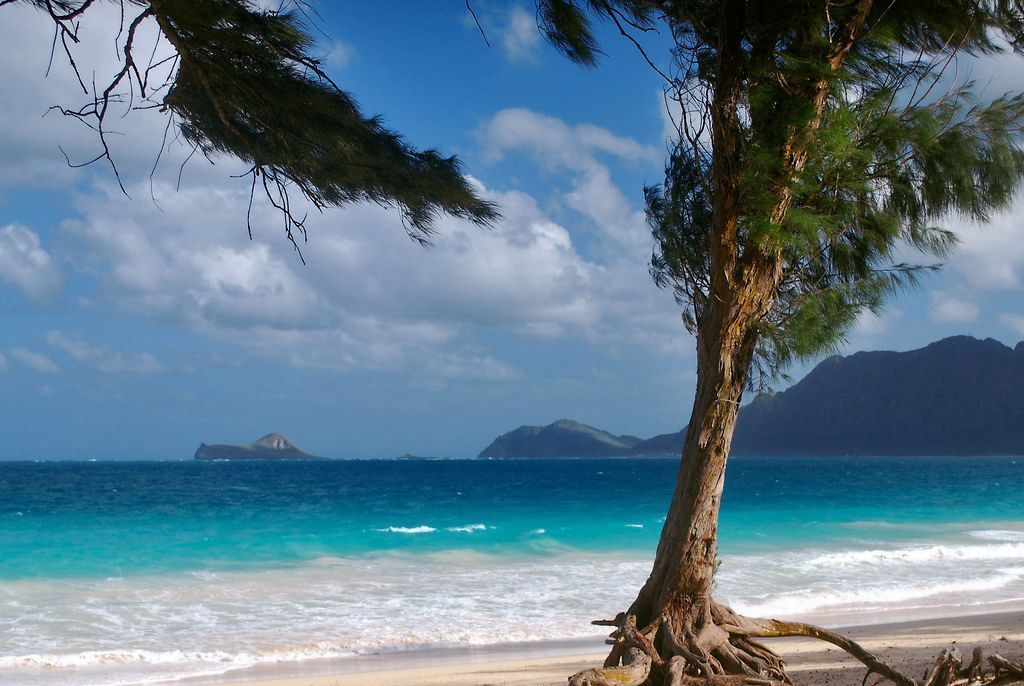
In yesterday’s sunset the sand had looked black. In the bright morning it shone olive green, laden with coarse mineral chunks like dulled emeralds. Looking up and down the coast, I could see in the western distance the head of land over what used to be Hunakai Harbor. The strand of beach trailed off southeast in the other direction, olive and brown struck through with black veins. Ironwoods formed a pale green bulwark between land and sea, bowed but unbroken by years of ocean breeze. Waves rolled in, churning the shorebreak into a sandy brown froth. Further out the water was turquoise fading with distance to dark blue. Submerged reefs massed in black clouds to outline the deep ocean’s edge. Two small islands sat offshore: sheer crags covered with guano and orbited by an armada of seabirds. Terns and frigatebirds wheeled and dove; albatross cruised like stately ships.
A handful of shirtless To’mean soldiers stood hand line fishing with in the shin-deep shorebreak. One staggered suddenly, caught himself and yelled out. His neighbor splashed over and wrapped strong arms around his waist while the first man frantically pulled in his line hand over hand. Finally they backpedaled up the shore, kicking up jewels of spray, whooping with glee and triumph. The others yanked up their empty casts and rushed to examine the prize. I strode down the beach to get a better look at the wet form but already knew from the Kane calls what it was. I’d learnt the word long ago—first heard it centuries before, spoken by one Kane grieving over his fallen brother. A dark forest at night, distant fires lighting the storm clouds overhead. A promise we made to the dead man but couldn’t keep. The word was Mano. The thrashing iron-grey form was a shark.
Young and small, just four feet long, it still fought so hard the angler lost his grip on the line. A powerful tail carved desperate swaths in the sand, pectoral fins digging for water but finding none. Its head took my breath away: flat and wide like a shovel, at least a foot wider than the slim body with a black alien eye at either pole. I’d seen drawings of these fish as a boy but thought them mythical, like unicorns. The To’means squatted, scooped sand with their hands and cast it on the fish. At first I thought this behavior religious.
Burial seemed to soothe the shark, like death made perfect sense to such a hunter. But it was not the end; one man knelt by the head to ease his obsidian knife beneath the broad plane and quickly slash free the line. The shark gnashed its teeth half-heartedly as the man jumped away. Another soldier brought his spear and much to my surprise, the rest started scraping sand back off the lethal creature. When it was mostly clean the speartip slid under its belly and the weapon became a lever to roll it over. Fins flopped awkwardly on the sand as they all started pushing it along, rolling the senseless shark back downshore. Seawater’s touch brought life rushing back, the men whooping again as they scuttled away. Wave action sucked at the mano and it was instantly gone, sliding through the foamy break. The fishermen—lawai’a, I reminded myself, another word based on the root wai—collected their meager catches and quit the beach. Nobody wanted to share hunting grounds with sharks.
I returned to the Red Tigers and found Colonel Staves had been through already, asking for me. I apologized for the abuse they’d endured on account of my absence and set off in the direction they pointed, passing a few tent clusters and more abandoned campsites, coming at last to an oversized five-post tent draped in red kapa banners. The High Speaker’s quarters, clearly. I was grateful to have found it without meeting an angry Staves. The familiar crest-helmed koali’iguarded the entry, stiffening at my approach.
“High Speaker Ienith Pele’iwa,” I stated clearly in Kane. One leaned down, pulled the flap back and signaled someone inside. Ienith’s herald Kapono emerged like an irate bull, snorting at my condition: clothes filthy and a bandage on my leg. He beckoned me in. The tent’s interior was more spacious than mine, but about as spartan. Only a table with three chairs distinguished it; that, and the unmistakable scent of a woman’s residence as opposed to the sour odor of Man. Ienith sat in one of the chairs, feeding on a fruit I didn’t recognize. Split halves exposed red-orange flesh and a pile of goopy black seeds separated to sit on the table. The High Speaker ate with a slender wooden spoon, slurping sweet liquid.
She looked up, saw me and did her best to smile. Her gorgeous face was drawn and pale. Circles loomed beneath her riveting eyes.
“Ashur. Colonel Staves told me you’d arrived.”
“I have. He was very gracious.”
“That is an unusual word for him. Have you eaten? Papaya.” Smiling, she offered the other half of the fruit.
“Thank you, my Lady—Ienith,” I corrected myself. “Food’s been provided to the troops. It’s better than most armies eat. Most I’ve seen.”
“And I imagine you’ve seen a great many. My people love to eat; it’s who we are. Fishers, farmers—not miners.”
“I’ve heard they forge metal in Hoku’e, all day long.”
A raven eyebrow shot up. “You’ve heard that? Meet a few pilgrims in the mountains, friend Ashur?”
“No, I just—I didn’t hear it. Read it somewhere.” This seemed to satisfy. Changing the subject, I continued, “did the Colonel tell you what happened in the valley?”
“He did.”
“Everything with the Speaker?”
“Speaker Ka’ena was a talented man,” she nodded grimly, “but difficult. The gift of flame can warp the mind. The Colonel knew he might be difficult. Warfare pushed a troubled mind to its breaking point. It’s happened before.”
“Ka’ena’s mind was broken already. From what I saw,” I added, accounting for my own ignorance.
“Oh? What do you know of it?” Surprised and curious.
“Nearly everything, and certainly more than Staves. I was your scout, remember? So I scouted.” I laid out the story for Ienith, just as it happened from the boar attack onward. By this point it was a massive relief not to lie. She stopped eating listened and chewed her lips instead. As I detailed the challenges facing the Speakers in the mountains, her face fell to despair. I mourned ruining such a lovely thing. “So it might’ve happened first in Kaleikaumaka,” I concluded, “Ka’ena might’ve been a special case. But the wai kalepa weren’t happy and the Speakers don’t command enough support to outweigh buckets of cowries. If Keone offers a better deal than the Speakers have, they’ll take it. Some of them might even take a bad deal just out of spite.”
“It will be easy for them. Wai kalepa have always bargained as one, working together whenever they could. To get the highest prices. It’s water and cowries with them, always. Give ilio an ear and he wants the whole pig.”
“They don’t see it that way. They say you have no right to rule them.” I was careful to temper my tone.
“Of course they say that. Cowries are mana. Hai’oleo is manatoo. One way or the other, if you wield it…” she trailed off and shrugged.
“Well, you’ve certainly got something. I saw what you did at the harbor. It was incredible. God-like.”
She sighed, irritably gouging papaya with her spoon. “It was a mistake. Ka’ena was a mistake. I’ve made too many these past few days.”
I didn’t know how to answer. “The Colonel said you’d fallen out of favor somehow. What’s on your mind? What can I do?” A better question to ask myself: why did I want to do anything? What business had I offering my help to a sorceress?
Ienith stood up from the table. “I want to walk on the beach,” she announced, “and think.” She took up a red-and-yellow cloth, wrapping it about her shoulders like a shawl. Beneath she wore a simple white dress with broad straps over her bronzed shoulders. “Come think with me, Ashur. The immortal man must have some wisdom.”