Speaker for the Gods, week 9
The Road to Noio Koha
I shut the book when Iokepa stirred. Our bags were packed, all preparations made, and now he’d caught two hours of sleep before our departure. I’d eaten, drank and done my business in a bucket when Hina forbade my going outside. As my companion blinked himself awake, the trials ahead loomed large in my brain. Prime among them: when and how to tell Iokepa I wasn’t Keone’s spy. Ideally once we were safe with Ienieth’s allies—those Speakers who didn’t cut folks’ heads off. Which brought up the next challenge: how to travel east through a forest likely crawling with the enemy? It would be days before my leg mended enough to hike on my own, and until then I’d be useless fighting. Whatever Iokepa’s designs against the Speakers, I didn’t trust him to sell the idea before Keone’s men slaughtered us both. Together these facts comprised the third challenge: a balancing act. I needed this young man’s help to reach safety, but he’d withdraw it the moment my lies became obvious. Gracious as his father had been, terrible as Kaleikaumaka’s plight might be, I wasn’t walking into hostile arms on Ioane’s behalf. Nor, I reflected in a self-serving afterthought, would I do him much service allowing his son to do so.
Hina bustled around the house in candlelight and the nervous electric hum just before dawn, gathering up any odds and ends we missed. Strings of kukui nuts looped over Io’s shoulder in an oily black knot because they’d sully anything in the bags. We each had a sack of supplies: food and water, a length of rope, fresh kapa bandages. The full satchel tugged at my shoulder and Iokepa balanced his pack’s heavy weight carefully while I tested out my new crutch. A simple wood contraption sized more or less right, strips of soft bark padded its head. It would blister and bruise me, but there was no way around this. “Auntie” fed us one last time with a suspension of sweet rice in cold water that tasted so good I guzzled a second cup.
We moved by feel out of the front door, Io clucking his tongue softly at the dogs to keep them silent. The compound atop Kaleikaumaka was empty but for the two soldiers stationed outside the Speaker’s hut. Whether by our stealth or their poor alertness, we went unnoticed for those crucial few yards. Ducking behind Ioane’s house and through a clutch of chest-high vegetation, we reached the plateau’s rim where it fell steeply down to the lower level. Iokepa felt his way along damp fenceposts until finally he found the right spot. With a grunt and a push the post bent outward, opening a narrow gap. Being the thinner, I went through first and took Io’s bag while he forced himself through. We slid down the slope on our rears, hoisting the bags once again at the bottom and setting off through the fields. Iokepa’s feet knew the village—each pit and stone in every path—and my new crutch made keeping up a labor.
We made it to Kaleikaumaka’s northeast edge without incident, having only startled a pair of coupling teenagers who retreated tittering like monkeys between the banana fronds. Iokepa elbowed my ribs. We came to a trailhead leading east; my guide held us up a quarter-mile later. He wiped sweat from his brow, gulping water, winded and nervous. For a long minute the only sound was wind slipping through the trees’ black morass. The moon peered half-lidded between them.
“How you doing, brother? That crutch okay?”
“It’s fine.” The thing would kill my shoulder over the next few days, but I was better conditioned to the road than my young partner. “You do this much? Traveling overland,” I asked, taking two sips of cool water before tucking the skin back in my satchel.
“Used to, but not so much since ka got me counting cowries all day. But I always liked eating pua’a more than catching it, you know?”
Iokepa took us off-road when it turned north, dwindling to a hunting path lined by ferns and trees overgrown with ivy. Instead he went hacking through the jungle, carving an eastward path for the next big ridge. He used my flint and tinder to light a kukui nut, and it sparked into slow-burning light. I was amazed at the clean flame, the purity of the oil inside, and followed it swaying through the darkness. A flash shower passed overhead, soaking the top layer of soil so my crutch sunk right through it. Even once it passed, the high canopy kept drizzling cold water for a long time.
The water had snuffed out our candle but there was now enough light in the violet sky to see. I found it hard going without clean level ground; my crutch constantly sunk in mud or glancing off the undergrowth’s gnarled roots. My left foot kept coming down for support, sending shocks up the leg. For all the pain, the limb bore surprising weight and couldn’t really be hurt worse at this juncture. Well-maintained, barring infection, it would heal quickly.
I begged for a break halfway up the ridge, as the dawn erupted over its high mossy crown. The skin of my armpit, totally raw, stung with my shirt’s sweaty abrading linen. We drank again and had a clear view of the town behind and below, the ridgeline’s shadow retreating under the Sun’s salmon-pink onslaught. Faint human forms started the day’s work in the fields.
“Io, tell me something. Do you believe in Ku?”
He was puzzled; I’d asked the wrong question. “It’s like asking do I believe in rain. Ku is.”
“Because of hai’oleo.”
“Yeah.”
“What about the other gods? Ku, Hina, Kane, Kanaloa. Do they all have their own Speakers?”
“Ku’s the ka like Hina’s the wa. He speaks the loudest. But they all have their domains, yeah? And each holds the others up, so you can’t get Kane widdout Kanaloa, no Ku without Hina. All a family.”
I nodded. “Those things were fascinating when I was a kid. The stories everyone had and the connections between them. Never much for belief, but the best stories always have some little pellet that’s true.”
“Wish I could’ve done nothing but school all day. Read, write, talk story. No hauling my ass up and down the nahele.”
I knew that meant forest and felt proud of myself. “That’s a nice gig if you can get it, but they did things differently where I grew up. No girls.”
“That’s for real?”
“Oh, yeah, and they really meant it. How’s that supposed to end well? It’s pressure, it’s physics,” I snickered.
Io laughed along. “One look say you’re no fighter, so maybe brother Ashur is a great lover like in the books. Too white for a spy. What are you doing on this island, my friend?”
“Just trying to get by,” I replied, getting to my feet and replacing the crutch under my hissing arm. It was enough for him. We climbed through warming muggy morning air towards the dawn.
We crested the ridge in nascent light, doubling over with hands on knees. To’mea lay out before us like a sleeping beauty, her green skin glowing in the dawn and covered only by a few tantalizing wisps of cloud. Greenery unfurled in an unbroken carpet as far as the eye could take it: down through the narrow wet valley below, up its far side and seemingly forevermore. Wooded mountain ridges stretched beyond like swells rolling in. In the distant south, white waves crashed on a dark lava coast. I couldn’t spy the great east-west road.
“We going down?” I asked my guide.
“Yeah, we already took the shortcut. Noio Koha is still two valleys and two ridges east of here. Maybe get there by sundown tomorrow.” Iokepa pointed towards the morning sky’s most blinding region. The Sun’s fingers worked their way through my shirt; it felt glorious after the night’s damp.
I shuffled sideways down the steep path mined with tree roots, carefully setting the crutch and levering my body downhill in deliberate steps. Io went first and stood by at the worst parts with arms out if I fell. The morning Sun sweltered on our approach to the valley floor, sending rivulets down Iokepa’s shorn head until we slipped under the canopy like into a deep weedy pond. The trees blocked most sunlight but enough had warmed the humid air to keep our sweat flowing. We took a break at a cool clear stream to soak our skulls and fill our waterskins. Birds flitted silently overhead in gaps between trees; the heat seemed to stifle their songs.
“Hey, got a question,” Io started, cleaning sap and fiber from the machete before handing it back. We didn’t need it anymore, the undergrowth being light enough down here.
“Yeah?”
“You really kill a pua’a with that machete? No spear?”
“One lucky hit when he was hurt already. The dogs tore him up.”
He nodded. “They’re good at that. Real sweet though. I used to run with da ilio all day, ‘til I fell over. Then Auntie Hina would bitch how I ate.”
“Hey, you don’t have to answer this; your family’s been so good to me. I don’t want to be a bad guest, prying. But I do wonder why your dad would send his only son away for school. Seems like there’s work enough around Kaleikaumaka.”
Io waved away the filial drama my statement implied. “I was shit at everything. Hurt my foot real bad trucking wai and I couldn’t do the runs no more. Tried working with cowries but I didn’t know anything about numbers back then. Ka didn’t have time to teach me with wa dead, so I went away.”
“Seems like it turned out okay.”
“Ka was righ’. Man’s always righ’.”
We hiked hours without incident, crossing the valley floor at my fastest pace which was still quite slow. I’d ask Io names as we went—these valleys were awawa, gouged from the high mauna—and after enough questions he started pointing them out unbidden. Ferns were kupukupu, the variants that built their stems up into six-foot trees named hapu’u. Acacias with thin crescent leaves had bark too dark to be koa; Io called them koai’e. Stuck to their trunks were sheafs of cream-colored fungus veined with orange: kukaelio. Sharp narrow gullies were kahawai.
“What’s kaha?” I asked, recognizing the sound wai.
“Cut,” Io replied, swiping one hand held flat like a blade.
“So the name’s ‘cut by water,’ more or less.” He nodded and I smiled to myself. Kane’s modular nature is marvelous for its students. One need only know the core to describe—albeit without the tongue’s native loveliness—what he means.
We crested the valley’s far side in the afternoon. Resting at the top, we ate dried fish and sticky rice wadded up in leaves under the shade of an ohi’a lehua tree. Its flowers were wild tufts of fiery red so bright they seemed painted. Bees alighted and drank amongst the fibers before flitting to their next dalliances. Thick leaves sprouted delicate fuzz, spindly limbs reached for the Sun like a man drowning. Everything growing in these woods did so at a desperate pace. These islands weren’t kind to anything standing still. I’d seen almost nothing from before the Calamity—all submerged and swallowed by the jungle.
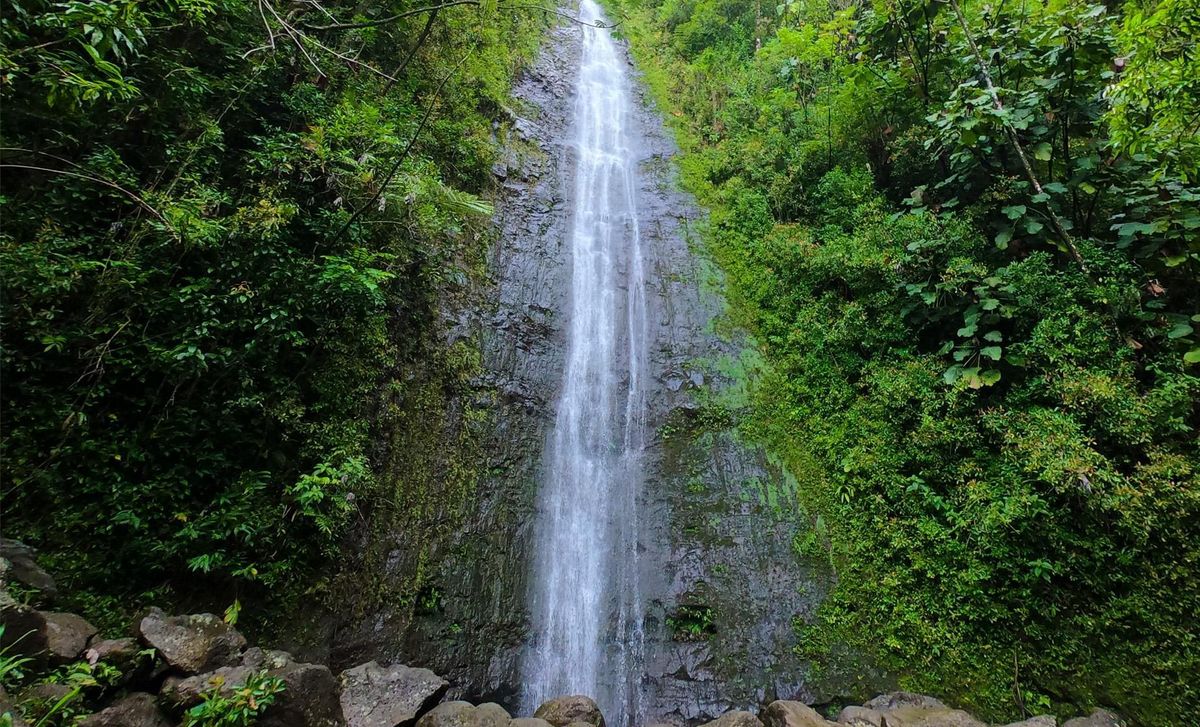
The Sun was hotter than ever as we descended, but less obnoxious for beating on our backs. My face was already burned enough. The awawa lying below us was wider than the last, its eastern wall dwarfing the ridge we’d just climbed. A brown smear of a village nestled in the back, huts shadowed by the tall mountains and huddled around the base of a large waterfall like piglets at a sow. At the valley’s mouth another town waited near the great east road that wound out of sight behind rocky brown bluffs. Two columns of dark smoke rose ominously, their sources in the town obscured. The ocean wasn’t far south from there, the waves an unbroken white wall holding back all the blue. I saw no trace of Keone’s army but the smoke, which could’ve been anything.
Io pointed out our destination at the peak of the far ridge. A dark cluster of buildings marked the town of Noio Koha: the richest town on an island that ran water down the mountains and cowries back up them in parallel rivers. My guide outlined its history while he hiked and I gimped. More independent than most, the loca wai kalepa kept peace with their Speaker but had nonetheless built a solid wall around the whole settlement in an unsubtle gesture of self-defense, anticipating a war that never came. In time the town had grown beyond the walls, and now some hundred families lived in a stretch of stilted houses spilling down the west slope towards us. If I squinted I could make out their lumber between the trees. Past Noio Koha and down the mountains waited rich windward farmland: the very same path Friar Waldman walked on his way to Hoku’e.
A single large stream fed the valley—I’d seen nothing on To’mea worth calling a river. We heard it two hundred yards before it finally resolved from the ferns carpeting the ground. The water ran deeper and broader than the drizzles we’d crossed before: fifteen feet across, brown and murky with silt. Io plunged a stick in near the bank, and by the water’s speed judged it chest-deep at worst. Two healthy men would have stripped, lifted their packs overhead and waded—but I wasn’t about to fill the hole in my leg with dirty water. We went upstream a half-mile looking for a better crossing, finally stumbling on a shallow rapid built from black lava rocks.
Iokepa offered to range further and search while I waited, but I refused. We’d taken enough time already and I still hoped to make Noio Koha that night. I undressed and waited while Io ferried all our gear across in two trips. He took my crutch last and settled on the far bank to watch me crab-walk backwards over the rocks wearing only my leg bandage. The water ran over my hips, so frigid I growled between my teeth to keep from shrieking.
It took several minutes to make my way across, Iokepa laughing his ass off all the while. By the end I shuddered with cold, my palms and feet numb and my ass rubbed absolutely raw. Io handed over my pants and while I bent to put them on he smacked one smarting cheek as hard as he could. It sounded like a thunderclap and I yelped at the canopy while he danced away from any retaliation, belly shaking with laughter. I finished dressing and saw he’d filled my waterskin to apologize. We were moving before long. Every bit of me ached and the hole in my leg hurt badly as ever.
In a stroke of luck we found a path heading our way, almost certainly bound for Noio Koha. Io had already named most of what we saw, so I described our surroundings in terrible broken Kane while he clucked gentle corrections. Eventually I was too worn out from hiking to spare the breath and we trudged on in silence. I’d convinced him to push past dark, the better to avoid the Speakers’ attention. In truth I feared what the night might bring. Keone may have passed over Kaleikaumaka, but the rich and rebellious Noio Koha with its high walls was an obvious target.
The Sun faded behind us as we approached the valley wall, red and orange reaching across the sky. The Friar wrote movingly of the brilliant Kane sunsets and they absolutely lived up to the billing. Hungry and exhausted, I refused Io’s suggestions and insisted we press on. I felt a nervous pressure building up inside, like a full bladder I couldn’t relieve. Jungle trees cast dramatic shadows over the dead leaves. Gusts of hot breeze would set the darkness moving like the earth itself menaced us. Sweat stuck the shirt fabric to my back and elbows, searing my armpit’s raw skin.
Io stopped suddenly, seeming to listen. I pulled up behind him, stilled my breathing and whispered what was wrong.
“Somebody moving.”
A few beats of silence, four ears straining together. “I don’t hear it.”
“I lost it too. Maybe should have brought ilio, but I didn’t want them barking once we left the hale.”
We let the forest breathe for a full minute before resuming motion. Fear enveloped 7us both, sure as the night descending. I could see stilted houses through the canopy as the path led uphill, ringed and linked together by red lumber platforms that resisted gravity better than any single support. Just a few hundred feet above us, it lay up a well-made road snaking up the ridge. But then I heard motion—not senseless crashing as the pig had done, but low and even. Somebody trying to move softly. Many somebodies.