Speaker for the Gods, week 8
The Water-Sellers' Plot
It was dark when I woke and surprisingly cold. I’d dreamed but could only remember a brief moment: running pell-mell across a desert plain as tornados descended from clouds like the gods’ very hands plucking at me. My mind, still shaking off fever cobwebs, struggled to orient itself absent the Sun. The logs in the stove had burned down to glowing husks; firelight flickered in through the windows accompanied by voices. I rolled to my right hip, rose up on a knee and two palms and crawled slowly across the floor on until I could pull myself up on a windowsill. Curtains were drawn to keep out the evening insects, so with one finger I slowly teased them open.
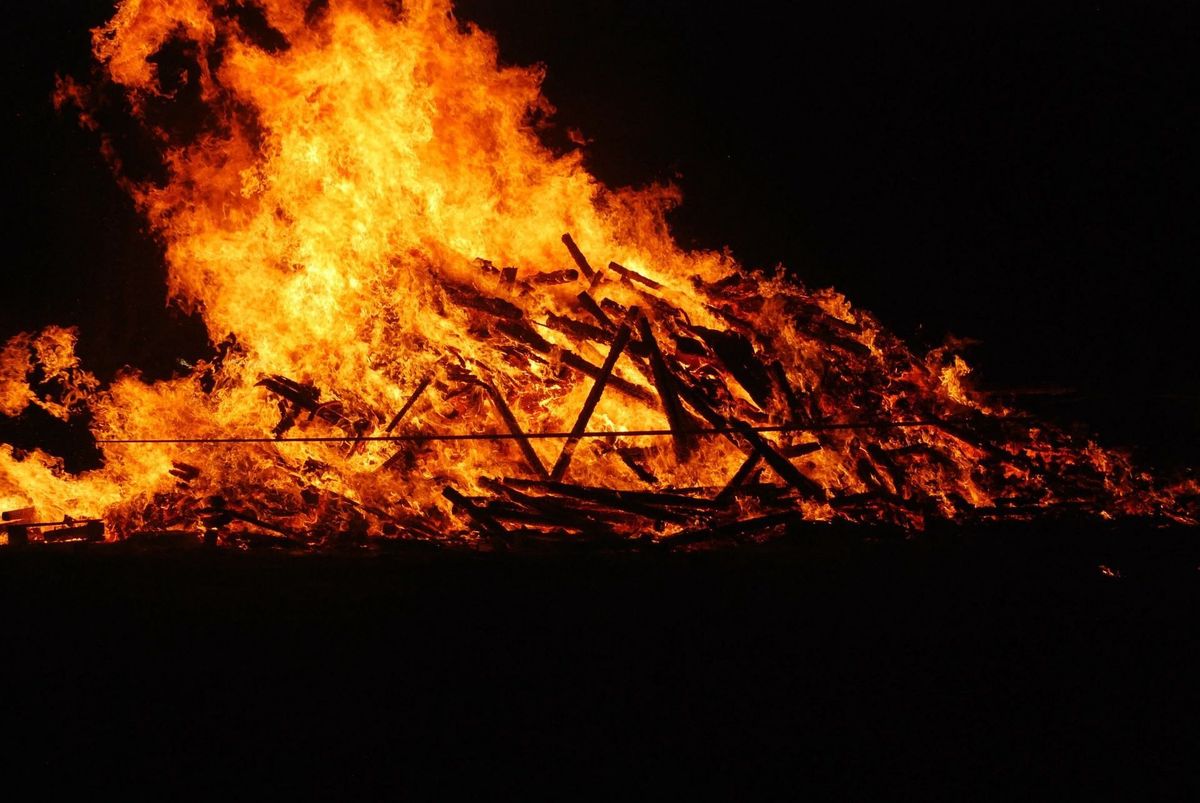
Outside a funeral pyre raged: lumber and kindling built into a waist-high cairn and crowned with a shrouded human form. Iokepa’s whole family stood outside, the patriarch Ioane in dialogue with an imperious old silver-bearded man. White robes hung from his wiry frame, chest obscured by his braided whisker rope, and he wasn’t afraid to stand close and look up to the enormous wai kalepa. Speaker Ka’ena scowled when he wasn’t speaking, but the discussion seemed otherwise civil and his two guards held their spears with easy grips. That was a relief; it turned my stomach to think of my hosts’ heads on those spits. I wondered whose body burned on the pyre.
Feeling rested enough to move, I cast about the room for a crutch. Nothing was obvious and my search was cut short by Iokepa’s entry through the front door. He slipped through and shut it quickly behind, his face glistening and hands black with soot.
“What you doing up?”
“Trying to find a crutch. I’m feeling better.” I worked my way to a chair and sat at the table.
He shook his head, approaching me. “You’re staying hid tonight. Speaker’s outside.”
“What’s he want? And who died?” Bowls of food were still out from hours before, covered in thin cloths to keep off the flies. I lifted their corners until I found the pork and tucked in with my right hand as I’d seen the To’means do.
He threw back his head to let out a barking laugh. “You did! That’s you out there, brother! Pua’a got you good.”
Now the pyre made sense: they’d lied to the Speaker, told him I’d perished and sent a grass dummy to the afterlife in my place—wetted down to convincingly slow the burn. “Your father’s plan?” I asked as Iokepa nodded. “Smart man.”
“You better hope so, haole.”
“It’s Ashur.”
“Don’t like haole? It doesn’t mean nothing. Just…you’re a haole.”
“Fair enough, Iokepa.”
“It goes like kay-pa.”
“Got it. Did you want to eat? You should probably wash up first.” I poked my elbow towards a water gourd.
“Nah, I gotta work the pu’uahi till it’s down. Just came to check, see if you ran off or did something dumb. Stay put, yeah?” He stood and went to the door.
“Hey,” I called at his back. “Thank your father for saving me.”
“You thank him yourself. He’ll talk to you later,” he said before slipping back out.
I surveyed the map of To’mea in my leatherbound book, tracing paths along its grained leaves with my fingertips. Having traversed the island’s neck and seen both the north and south shorelines stretching many miles, I knew Los Angeles and her dock couldn’t be there. She was two hundred feet bow-to-stern, if I’d read the manual right, and a base large enough to house her and barrack her crew would be too obvious to survive centuries in plain sight. I’d seen my share of pre-Calamity tech—the old folks hid huge facilities underground—and decided it would be buried near the coasts. I sought a stretch with sudden terrain falling off steeply to deep open water. The Friar’s writings from the far side of Mau Pu’eo described shallow slopes with sandy beaches and barrier reefs offshore, just like those I’d already seen. Between our four eyes, we’d effectively surveyed To’mea’s whole leeward side with nothing to hint at a hidden installation. The simplest answer is often the best: Los Angeles must be on the windward side. I would continue east as my leg allowed, re-read the Friar’s full account and hope for an epiphany.
Ioane came in with his son in tow, fire in his eyes and a sneer of contempt on his face. He fulminated in rapid Kane and swept his hands around in gestures made frightening by their sheer size. Iokepa carried a long string of black kukui nuts, the bottommost of which burned with a bright white flame. The giant glowered at me, took a deep breath to compose himself and sat opposite me with his boulders of elbows on the table. Iokepa used his burning kukui string to light two candles, snuffed out the nut and brought the candles to the table. I waited while the son sat beside his father, too self-conscious to speak first in Kane.
Ioane spoke and Iokepa brought up the rear, translating his words into English. I did my best to pick out the most important words and etch them in my brain. Every little bit helped.
“He’s asking where Keone’s at. And his men.”
It was an odd question. “I don’t know. I spied some on my way up the mountains two days back, marching east down the Great Road. Saw none in the forest.” This was relayed, and Ioane donned a frustrated look. He spoke again to his son.
“Says you don’t gotta lie. He wants to know when Keone’s coming.”
“Maybe he sent men up the valley, but if that’s so I saw nothing.”
Iokepa translated and the old man rubbed at his eyes before replying. “Then why are you up here? With that weapon you carry you’re no kind of ‘a kama hele.”
I assumed that meant traveler. “I’m on a mission for the Speakers. High Speaker Ienith Pele’iwa?” Looking back and forth, I saw no recognition at the name.
Ioane laughed then, worsening my confusion. He gently punched his son’s shoulder. “He say you’re a bad liar. High Speakers sending haoles alone through the forest on errands? Nobody’s gonna believe that.” Iokepa’s tone was apologetic, like he was trying to help me out here.
“Of course he’s not!” I threw up my hands in peace, brain working furiously to decode the big man’s assumptions. “I was here before Keone landed. I came from across the sea.”
He looked relieved. “We figured that much out. Keone’s got spies everywhere. So what do we need to do here? We’re ready to fight, brother. All the wai kalepa.”
Oh, shit. Revelation hit my skull like a hammer. Io’s earlier words about Speaker Ka’ena had been more pointed hint than exposition. Kaleikaumaka was on the verge of revolution—eagerly awaiting the conqueror, its water merchants at least. In my experience with political disputes the richest men tend to prevail. Ienith underestimated the situation in the mountains, or perhaps she’d suspected this all along. Whatever the case, Ioane thought I was Keone’s spy. For now that made him a friend. Still trying to think my way through this new situation, I stalled for time by acting dumb. “You don’t support the Speakers?” I asked, feigning wide-eyed surprise.
Ioane snorted and spat once his son relayed my question. He went on a tirade, Iokepa struggling to keep up. “Ka says we’ve traded wai and build Kaleikaumaka for generations. ‘Ohana apa’akuma. The fresh water gives life, yeah? Well, Ka’ena come from the salt water, far away. He knows nothing of life, only death. He’s a monster, was a monster in the wars and got sent up the mountains ‘cause the other Speakers were too scared to kill him. When word came Keone landed on the island, Ka’ena went mad. Shut down the wai runners. So no cowries for the wai kalepa, and no wai getting to the people below. Some tried to smuggle it down, but Ka’ena found out and they were done.” Drew a finger across his throat.
“Jesus,” I shook my head, remembering the putrefying heads outside.
“All of the Speakahs are fucking with Kupono.” Ioane had finished his speech and his son thought a moment about that last word. “The right way of things.”
I stroked my chin, mulling the situation over though I still knew too little to make good choices. “Would the people support you in a fight?”
Ioane stood from his chair and spoke while pacing, great tattooed arms on his hips, muscled back like a mountain face. “Kaleikaumaka will get behind the man,” translated the son, “who keeps their lives safe and happy. The lahui just want crops growing and their children fed, the wai kalepa want their cowries. You bring Keone’s koa to help us fight and we’ll do what needs doing.”
“Isn’t koa a tree?”
“Yeah, means ‘soldiers’ too.”
“Oh, like koali’i. So you want me to trek through the jungle on one leg until I find soldiers? I’m a spy, not a ranger,” I lied through my teeth, building a story around the fictions they already believed. “Nobody tells me Keone’s movements, not even the date of his landing. If his troops are in the valley, I don’t know about it. But,” I bought some time with a drink of water, finally devising my solution, “I’m to meet a man in Noio Koha—my contact from the King. I can take you to him. He’ll know how to help you.”
Ioane’s eyes narrowed at the other town’s name, but his face relaxed as Iokepa explained my proposal. “It didn’t seem too far on the map,” I continued to press my case.
The big man seemed satisfied once Io finished translating. He gave what sounded like instructions to his son, patted his shoulder with surprising tenderness and crossed the room to wash his hands in a water basin. Iokepa turned back to me, red-faced. “Okay, we’ll do what you said, but you and me are going together. Uncle Hiapo’s gonna cut a branch and make you sumpin’ to lean on. We got a couple hours ‘til the fire burn down and it’s dark again. Hina and me will get the packs ready. See how far we get by sun-up.”
I could only nod. Ioane had finished washing and now walked heavily to the partitioned bedrooms—mat-rooms, I suppose, since nobody bothered with proper beds. He made one final pronouncement before disappearing behind a curtain of polished red beads.
“What was that?” I raised an eyebrow at Io.
“Says don’t fuck up.” He tried to smile but was clearly anxious.
“Things might get violent in the jungle. You know how to fight?”
“Nah, not much. I busted a guy’s nose once in school.”
He was still my best way out of a sticky spot, and our path should keep us clear of combat. “Well, then” I chortled, cracking open my book again and setting my bad leg up on another chair. “We’ll make a fine couple.” Friar Waldman’s narrative resumed while my hosts got to their furtive work.
“I departed Ephrem’s school in the dead quiet of night, slinking out from Hale Hau’oli and up the north road towards Hoku’e. Quickly finding the spot Kai mentioned, I settled in to wait and was at first surprised to see a pair of shrouded figures climbing behind at some distance. They passed oblivious to my presence and were followed minutes later by a half-dozen women of various ages with their heads uncovered. These were pilgrims, travelers hiking from all across To’mea for a chance to visit the City of Stars—its name made obvious by the cavalcades of celestial bodies visible overhead through the thin atmosphere. The pilgrims’ droplets swelled to a solid trickle before Kai finally came into view, late to our clandestine meeting but walking with swift purpose. Together we made our way up the flank of Mauna ‘Ele towards where the road met the capitol’s gates. Supplicants congregated, huddled together with their packs and walking sticks in the high morning’s chill before the astounding black basalt walls. Most were women and old men; I saw no children among the hundred-fifty there assembled, and from this evidence I surmised they weren’t permitted within the gates.
“How, I asked my host at this juncture, were we to enter the city? Kai produced a thin wooden disc from his pocket: red koa, smooth on one side with the other displaying a crude sort of family crest. I had seen these tokens before, here and there, and knew them to be hiapa: To’mean family crests, passed between the firstborn in each generation to stand as enduring symbols of citizenship. Though typically of no practical use and extant only as extensions of a great tradition, hiapa were decreed by the Speakerage to be the only keys of any worth at Hoku’e’s gates. Kai’s was that of a crowing rooster amidst long strokes meant to represent grasses. At the same time it was obviously incomplete, carved only on one side while the other had been sanded smooth. I delicately inquired as to the reason for this—every hiapa I’d heretofore seen was carved on two—and his response proved my instincts correct: the disc reflected his miscegenated heritage, his half-mixed blood. His own firstborn, he explained, would carry a three-quarter sigil; provided, naturally, his wife was of the Kane race.
“Kai’s plan to enter the city involved some subterfuge. He had visited Hoku’e before, sneaking off one similarly early morning to keep the disapproving Deacon oblivious. He believed ardently in Luther, he claimed, but had been drawn to the City of Stars since his boyhood gazing up at her black walls and stern parapets. He was eager to show me, eager to have the information recorded in writing. He was, after all, a devout servant of the Learned Word. That higher purpose justified the subterfuge we’d require to pass the gate’s threshold.
“I was skeptical of his plan, to say the least. I am, as the Kane say, haole, and could never pass for a man of the islands. But Kai’s mixed blood was equally obvious along with his half-sanded hiapa. With my cowl up, mouth covered and cheeks rubbed with volcanic grit, I could pass for his deathly ill brother. Hunched, sick and wasting, I’d present Kai’s token for the both of us. With my companion at my side to persuade the guards, the plan stood some chance of success. Fraud attempts must have been vanishingly rare, given the few foreigners even extant on the island. Just a day before, a vaguely plausible entry to Hoku’e had been beyond hope. I offered a prayer of thanks then, silently, for Providence’s hand.
“When the gates opened at long last, it was to the sound of thunder. A mighty peal of noise issued forth from behind the pair of whole-wrought iron doors, accompanied with a blast of infernal wind that pulled the hood off my head and set me scrambling to replace it before anyone could glimpse my pale face. The doors were twenty feet wide and perhaps thirty-five tall, demonstrating a scale of construction and metallurgy present nowhere else in the Kane realms. The best smiths on the Mainland haven’t the facilities to forge anything at this scale, in solid pieces. Words from pagan gods rolled up and over and through the metal. My insides quaked and my hands twitched reflexively towards the Lord’s sign, but keeping the perilous circumstances foremost in my mind I refrained and showed none of my dismay. The doors opened slowly from the inside out, trailing long heavy fixed to the harnesses of oxen facing away from the gates some ten yards inside them. The animals could pull the gates closed, it appeared, but the To’mean Speakers’ unique sorcery seemed the only method of opening the mammoth portal. No handles, rivets or studs graced its outer surface, nothing for prybars or hooks to get the smallest purchase upon in the highly unlikely event of a siege. It is difficult to conceive how even the most resolute general could, without some substantial material advantage of his own, even approach the capitol to besiege it.
“Soldiers with bare chests and strong arms emerged from the gates along with a comely female Speaker in the white robes typical to her order. Whether she issued the call to open the gates, I cannot say, but she stood impassive and impressive with arms crossed while her men set up a queue for those of us outside. Hiapa were presented, examined and handed back to these awed pilgrims among whom I was honored to count myself. Though some endured more scrutiny than others, ultimately each was accepted without meaningful challenge and this gave me reason to believe our plot would succeed. Carts were appearing belatedly, having wound their way up through Hale Hau’oli behind the cloaked people who would only clog the road, each wheeled apparatus piled high with fruits and vegetables and livestock from across the island. Fish came in by the basket, so freshly dead they smelled like nothing but clean salt, and they were received along with the other foodstuffs by robed workers from within the walls. One conspicuous absence from this litany of supplies: water. The heaviest and most expensive of To’mean commodities made no journeys up the volcano and only occasionally down it to Hale Hau’oli, the capitol legendarily fed by an inexhaustible spring.
“The merchants made their deliveries and took back ropes of cowries in payment, bowing and bellowing thanks while making no effort to cross the threshold. Their wares were carried away and finally they led their animals back downhill with empty rattling carts. Single file went the pilgrims through the gate while this proceeded, we among them, passing one after the other under the soldiers’ examining eyes. I bowed my head as we approached, bent my back, and affected a kind of waver in my hands while presenting Kai’s hiapa to the city’s stern warden. He frowned at the half-sanded disc, called to the woman behind him and handed it back to her while I broke out in a terrible sweat.
“The Speaker took the hiapa, saw its half-sanded nature, and began to exude superiority from her pores. She asked me, in Kane, the purpose of my travels. I was dying, I replied, coughing and rasping terribly to hide my foreigner’s accent. Kai started in immediately, telling such a vivid tale of affliction and woe that Ephrem’s schoolchildren would have fallen about sobbing. ‘You are a fine brother,’ the Speaker replied once he was finished. She returned Kai’s family sigil and I made a show of bowing and piteous coughing. We impostors shuffled under the black walls and halted in a nebulous mass of pilgrims.
“A single man, a guide, waited on the far side of the gate at the head of our formation. The flow of supplicants had ceased, the guards now barring the way and keeping a good many people outside. The others, Kai whispered, would have to wait for the afternoon. Three hundred sixty-six travelers each day, admitted half at a time in two cohorts. The others would seek lodging in Hale Hau’oli, a few paying for the privilege but most content to leech generosity from their hosts—Kane traditions insisting on welcoming and provision for strangers. The guide stood before us, wearing a crested helmet and a luxuriant cape of red-and-yellow feathers. The helmet’s face was wide open, serving alongside his splendid dress as pure decoration. Speaker Ha’aheo stood before us, he declared in a voice that was booming and imperious but un-magicked.
“We were not to stray from the road, nor enter any structure unless bidden, nor place our hands any article of statuary. Hoku’e’s primary avenue is broad and cobbled with red and grey stones, winding serpentine up to the mountain’s summit capped by the Grand Monastery. Constant traffic churned through the streets: men and women with hand carts, delivering foodstuffs, water and otherwise fulfilling the essential civic needs of any large urban settlement. The buildings on either side struck this observer as far superior in construction to any present structures on the Kane islands, excepting perhaps a few pre-Calamity relics. Heavy basalt stones fit expertly together, their edges too sharp for traditional Kane masonry. Most of their structures are made from hammered stone, not cut, and cobbled together like puzzle pieces without the benefit of mortar or cement. This construction is poor for sophisticated structures: the stones are subject to wear, moisture and gravity. What man sets just so, God will make just right. Put simply, buildings constructed in this fashion will eventually collapse without anything to adhere together their constituent parts. With limestone, fire and metal, mortar is not difficult to produce, but of this triumvirate the To’means, and Kane in general, possess only the first two. Yet the houses of Hoku’e were built finely from bricks fitting together as only something cemented could.
“I was desperate to query the guide, but would have been an utter fool to do so. In a stroke of luck he answered my question unbidden, attributing the city’s ancient construction to a single day’s effort by a single Speaker given the name Oleo’lani. I was familiar with the name but had thought it imprecise—a general term for the highest and most powerful To’mean sorcerers, attributed posthumously in a kind of beatification. In the case of this particular Oleo’lani, our guide claimed he raised the city from the hull of the very earth—his hands like knives, shearing flesh from the volcano’s flank.”