Speaker for the Gods, week 3
Kia'i Ku'ao
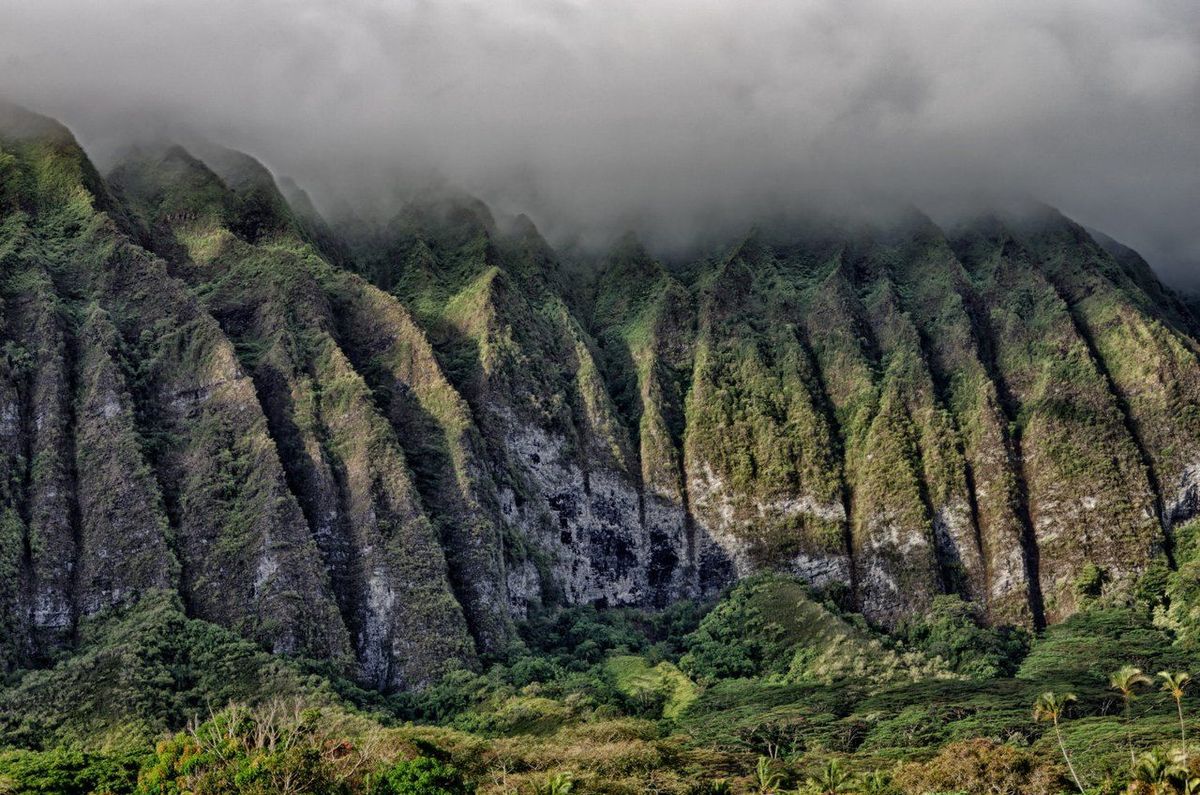
I woke when the cart rattled to a stop. My eyes shot open but my brain was still swimming towards consciousness, grappling with the commotion of men unloading gear mere feet from me. I sat up on the rough lumber bed to see the barest hint of rose blooming in the east. Thousands of stars still shone brightly overhead and I could see my breath. We were in the mountains surrounded by dense black jungle, a swath of which had been clear-cut and denuded of stumps. A great stone edifice stood before me, backed up against a sheer cliff: a central tower six stories tall flanked by battlement-topped wings roughly half the height of the keep. Torches cast dramatic shadows all about from their sconces high on the walls. The gates stood open, unworried.
Men from our caravan began to arrange themselves into a narrow file aimed at those heavy wooden doors. Instinct prompted me to scope out the clearing for easy exits, but suddenly Captain Staves was prodding me in the back.
“With the rest of ‘em, you.” The fortress’ interior was low-ceilinged yet better lit than the exterior suggested. At the head of the Kane column was the High Speaker and the man who served as her herald, flanked by caped and armored Koali’i. The mood was light if not quite exuberant. Men chattered gaily amongst themselves, shifted their packs from one shoulder to another, chided those in front of them to pick up their feet. I found myself pushed along with the formation, through an arched tunnel that formed a defensive chokepoint before a second interior gate. The space beyond was a wide hall two stories high ringed by mezzanine galleries, all the walls backdropped by a golden yellow cloth over black stone walls. Woven mats on the floor, dusty and smooth from the working of bare feet. Kapa cloth, the Friar had called it. Made from tree bast, it resembled linen with the fingertip softness of cotton. Suddenly a man’s chest was in front of me, formidably muscled. I’d been distracted but now looked up to the stern face of the High Speaker’s herald. She was nowhere in sight.
“Follow, sellsword.” He led me through the men, some of whom were preparing to bed down in the hall while others filtered up to the galleries.
“What’s the name of this place?” I asked. “It’s amazing.” He didn’t answer so I followed quiet and docile. The tapestries on the wall now alternated red and gold, each inlaid with figures of the opposing color. Men, ships, birds, fish. A larger man with a bulbous head and a fierce expression who appeared as a farmer, a fisherman, a hunter of pigs. I recognized him from the Friar’s descriptions as the god Ku, parent to the To’means along with the goddess Hina.
Under the mats the floor was a smooth polished plate of unbroken basalt, so long it must have been the mountain’s living rock. Dust described brown footprints new and old; old ash from wall torches made black clones of the same. We passed through a set of double doors guarded by red-caped Koali’i and the atmosphere of the fortress perceptibly changed. On the other side the light was brighter, but there were no more torches. Little orbs of yellow light lazed around the high arched ceiling and its support timbers, always moving and never seeming to get caught in the corners. They filled the place with a happy glow. The herald turned right down a narrow hall while the soldiers continued ahead, and suddenly we were alone.
I cleared my throat. “Sir, I mean no disrespect. I’d just like to know where I am.” He didn’t look back. It was maddening; what did he gain from playing the heavy? The corridors all looked the same, the tapestries blurring to scramble any sense of direction. Wood doors were spaced along both walls, simple and light brown with more pictographs burned black into their faces. We must have been deep in the mountain when finally we stopped. The herald put a palm on a door—marked with a crude human figure standing over a cliff. Wide hips marked it a woman, and below her the cliff dropped to the sea. Clouds billowed from the water: whether steam or smoke or foam, I couldn’t tell.
“The High Speaker waits inside with your Colonel,” he stated sternly. “The Lady Ienith, ka wahine ‘ai honua, will ask questions and you must answer.”
I didn’t understand his Kane; something about the woman. “I’ve nothing to hide, sir. I’d just like to know where you’ve taken me.”
He looked intently at me, moved his lips wordlessly while I spoke and took a moment to respond. “You’re a guest of Kia’i Ku’ao, third hana mana of Ku. Provisions will be made for you. Once she is satisfied.”
He pushed and the door swung open with an aged creak. In a small windowless chamber on simple wooden chairs sat Colonel Staves along with the High Speaker. Between them, a circular table labored under a heavy burden of food: fish, fruits, rice, ears of sweet-smelling white corn, taro paste. A green curtained doorway on the room’s far side led somewhere else. The same queer lights meandered around the ceiling and brown thatched mats blanketed the floor, warming the room better than the rest of the fortress. The walls were stone paneled with smooth pale wood into which innumerable glyphs had been burned, as with a red hot nail. Running my eyes around, taking them in by the hundreds, I noticed same bold symbols repeating in cycles—scrawled by many distinctive hands over generations. Staves wolfed food like he dined in a tavern. The High Speaker’s white cowl was down, letting deep black hair run like oil down over her shoulders. She’d been speaking to the Colonel but stopped short and turned to take me in.
Young but no girl—her late twenties, perhaps. Unblemished skin, almond-shaped eyes, a broad nose and a full mouth. Beneath heavy lids her black irises searched me. They seemed to survey the entire room at once. Her mouth split into a wide smile, its warmth slightly jarring after that long walk through stern corridors.
“Sit down. Eat. To have fought so hard and come so far, you must be starving.” I sat at one of two chars waiting empty. The food was served with ceramic plates and bowls but there were none to eat off; a stack of broad banana leaves served for serving. Fewer dishes to wash, I supposed while helping myself to fish on a bed of steaming brown rice.
“My Lady, I’m not sure how to address you…” I trailed off, hoping for a suggestion. She smiled and inclined her chin. “Well, my Lady, my name is Ashur. I’m a simple man and I’ve never seen the like of what you did on the beach. It was amazing. I assume that was your doing? I shouldn’t assume.” Quick hit-and-run sentences were safest with royalty, who were happiest when they could see you quaver.
“The fight on the beach was a matter of timing. Colonel Staves turned the tide,” she lifted a hand as if offering him a gift.
“Too kind, m’lady,” he mumbled through a mouthful. “No tricks from you and we’re rightly fucked.” The rough language surprised me but the High Speaker smiled, amused.
“The wall of sand, the waves,” I tried again. “The call over the wind was your voice?”
“Words from the Gods, given expression on my tongue. Hai’oleo is a gift.”
“I’ve never seen anything like it. Do all Speakers have such power?”
“The gift takes many forms and all serve Kane.”
“Kane…the people? Or the god? I know only a little.”
“Not everyone can admit this.”
“I’m an ignorant man, milady.”
She broke into a grin and let out a short laugh, the cracks in her seal letting out something so pretty you couldn’t look at it and still breathe. “Two guests at my table and both with quick wits. Well, quick tongues at least; we’ll see with time whether your lolo keeps up.” She tapped a finger against her temple. “Kane is man and god. He’s the world as made by men. Kanaloa, the world as it makes itself. Ku and Hina, ka and wa, watching their brood from a far shore. This won’t make sense to you.”
“I understand, milady. I’ve done some traveling and heard earfuls about what folks believe. They’re the same stories, just a handful going around and around. The symbols change but you can still see them. So I understand.”
“Good. That’s the old story. As for the Speakerage, most of my order are priests serving the villages,” she continued, taking a golden prism of pineapple between two fingers. “They do their work and guide their people. Most have no skill for war and others are too old. You won’t have seen them on any field.” She popped the fruit in her mouth and sucked the juice off her fingers.
The High Speaker’s brow furrowed, like she’d just thought of something. A band of sinew showed in her jaw while she chewed and swallowed. I opened my mouth to ask another question but she cut me off.
“How long have you served the Royal Red Tigers, Ashur?” A sweet smile spread over her features, dropping her prior intensity. My throat started to tighten. I couldn’t lie with Staves in the room.
“Only since this last night, my Lady. In truth, I’m not much of a mercenary. Just a traveler who’s longed his whole life to see the Kane islands. I didn’t realize there was a war going until they stopped me at the harbor. Colonel Staves was kind enough to sign me on.”
“He’s a resourceful man, the Colonel.” That was a strange word to describe him.
“Showed up yesterday at the docks with my new boys,” Staves chimed in. There was a little food left in his mouth and he took a second to swallow it. “Had his own blade and enough years not to spew at the first sign of fighting. Which you didn’t!” he exclaimed, pointing a spoon my way. “Can’t fight for shit, but you kept your dinner down.”
I was uncomfortable and served myself food to cover it up. Fermented taro paste, purple and sickly sweet. The Friar spoke highly of the stuff. I quickly decided it was awful.
“You came on the boat, then? Yesterday.” She was asking me.
“Yes, m’Lady,” I gurgled, and quickly cleared my throat. “The Ashkandi. Three weeks at sea, an honest captain and fine crew.” Fill her mind with banal details. Discourage further questioning.
“Was it a harsh voyage?.”
“Dull, cramped and leaky, my Lady.”
“Some days ago, there was a monsoon. Our island was battered for hours; whole fields inundated. Did your boat suffer the same?”
“There was a storm. I’m no sailor, my Lady. I know nothing of the weather at sea.”
She nodded. “Tell me, Ashur: what do you know of the Speakers?”
“Only what I’ve seen. I don’t much trust what I hear,” I fibbed, sure not to mention the Friar’s book. If she knew about it she might want to look at it. “There are stories across the sea—folks say you summon dragons. That you aredragons.” Another lie sent with a toothy grin, which she returned.
The mood was more relaxed. “I’m sure fantastic things have crossed your path. More wonders than all the islands put together.”
“My Lady, from what I’ve seen, To’mea is its own store of wonder.”
“What have you seen? Apart from the fight at Keneke beach.” It was a pointed question. Another crispy morsel turned in her fingers. Nerves once again knotted in my stomach.
“A child, a little girl—I couldn’t say how old. After we left the port, she was standing by herself in a dusty field. She was playing with the dust. Turning it in circles,” I mimed with a finger.
The High Speaker nodded. “Some come to the gift younger than others. A village Speaker has little to offer a prodigy. When she’s older, there is the Monastery in Hoku’e.” She referred to the capital, the City of Stars, barred to non-Kane. “Hai’oleo, like any voice, is unique. A singer can learn technique. She still must sing herself, and no voice but her own will move the Earth.”
“That’s beautifully put.” I pulled the crackling skin off a small fish’s flank and sucked out flaky white flesh.
“When words are your business, they put themselves in order,” she softly replied. I saw bashfulness in her downcast eyes. It didn’t last long; she collected herself warily and snapped her gaze backed to mine. “Surely you have talents. To have come so far in the way you have, it cannot be simply Ashur the Mercenary.”
“I wish it weren’t, and sorry to disappoint. I’m not even much with a sword. Certainly not a master like the Colonel.” Staves was sitting back—stuffed and as happy as I’d seen him—but the compliment narrowed his eyes. The fuck do you know about me? they demanded. “I’m just lucky to be alive, milady.”
Ienith pulled the corners of her mouth up mechanically, like puppets on strings. “A lucky man.” She stood abruptly and gestured to the door. “I’m sorry for my rudeness, Ashur, but I’ve war business with your commander. I expect business with you before long. You will stay here, at Kia’i Ku’ao. The herald outside will take you to lodging. Thank you for your company, and your service.”
“Just one more question, if I may. I should have asked earlier. But why’d you single me out on the beach? If it’s an errand you need then surely somebody—“
“We’ll speak when I call for you.” She was annoyed with me and I could tell it made the Colonel happy.
“Yes, ma’am. Good day, ma’am.” Supper was over. I put down the plate, gathered myself and moved for the door. Throwing a last glance over my shoulder, Staves and the Speaker were both fixated on me with very different expressions. He was irritated but just as blind to her motivations as I. Ienith Pele’iwa, for her part, regarded me like I’d already been sent on an errand.
The Herald had gone from the hall, replaced by a shorter man in a sleeveless brown wrap. His arms were bare of the inked patterns all the Koali’i wore and I sized him up as a worker rather than a soldier.
“Lotta haoles here tonight,” he remarked.
I could only agree. The turns of windowless corridors had stripped any sense of direction from my brain but in minutes we came to a set of tightly spiraled stairs finely crafted from pale unpainted wood. We climbed two levels and could’ve gone higher, but my guide peeled off to a landing and down another hall. The walls were bare up here, the red and gold tapestries replaced by rough stone walls. I felt a slight draft: the outside must be near, a window open. Men with soldiers’ builds passed us, conversing softly in Kane, always traveling the other direction.
We took one last left turn and found ourselves at a small cul-de-sac with three branching doors: dark and heavy wood, the walls between them decorated with purple cloths. Though the tapestries were flat violet without any obvious designs inlaid, dark shadows seemed to move deep in the dye. My guide opened the leftmost door.
“Stay ‘till she calls. You gotta mimi, the pot’s through there.” He pointed to the center door.
In the center of the room, resting on a thick mat of woven brown grass, were my duffels from the Red Tigers’ camp. How they’d beaten me here, I’d no clue. The door closed behind me and I heard nothing like a lock. They had to let me out to piss, I supposed. And how was a white man supposed to sneak out unnoticed? Candles lit the windowless room. Kia’i Ku’ao didn’t need a dungeon to hold me captive.
The brown mat was scaled to accommodate the biggest Kane and my bags looked tiny by comparison. Aside from the mat, the only furnishings were a rough wooden stool and a table of similar construction with a grey kapa blanket folded neatly on top. Two portals in the far wall cast distorted rectangles of sunlight over the stone floor, broken up by a grating’s black crosshatch. They augmented the light from the sparks that still moved over the walls. I moved close and peered up to see narrow shafts barred with iron, leading perhaps eight feet to clear blue sky. I daydreamed of turning myself into a puff of smoke and scurrying out the hole.
My bags were still tied with my favorite knot; the To’means hadn’t searched them. Did the High Speaker know what they held or what I was after? Did she care at all? The latter was more troubling, since I’d no earthly clue what she or her masters wanted. I tried not to dwell on those questions, since they couldn’t help me now. She had every intention of keeping me in the dark and the power to do it, so why swim upstream? Best to use the resources at hand, I thought, as my dirty battle garb went into a duffel and sturdy brown trousers came out. A linen shirt and fresh socks—any weathered traveler will tell you soft clean socks are a special pleasure. Rummaging through my lighter bag, I was pleased to see both books dry and undamaged. The Friar’s heavy leather tome was of little concern, but the other was fragile paper.
The “U.S. NAVY” book had been printed cheaply for easy disposal and yet had outlived everyone able to read it. It was Sun-bleached, but you could still see the hint of orange in the sad pink. An official-looking circular seal had bled itself into a solid inky mass. A strange boat dominated the cover’s lower half: long, tube-shaped with a single broad mast and no sail.
Behind the cover waited diagrams and detailed procedures I’d no expertise to understand. The ship was made to run underwater but could plow along the surface as well, rising and falling at will though every component was heavier than water. It was called Los Angeles, if I read right. I was to board it, find the engine and take a component if the thing was there to take. It was hard to say more because I didn’t myself understand the diagrams. I’m a quick study with a whole object in front of me, but this information was useless on its own.
At some point I put away the books and did my best to sleep without snuffing the candles—I didn’t want to be caught in the total darkness that would produce. Hours passed. I left the room to relieve myself, contemplated roaming the corridors, but men were still audibly moving throughout the fortress and I didn’t need any trouble.
In time my door opened: Two Koali’i stood at the threshold, armed and armored for war. Carved gourd helmets trailed long tassels to rest on shoulders tanned by Sun and ink. Spears rested their hinds on the floor while their heads wavered between callused fingertips. The soldiers wore shields on their back, letting them hang about their shoulders by brown leather straps.
“The Lady calls. Pick up your things. Awiwi.” There was almost nothing for me to gather; the book went in a bag, the cutlass slipped into my belt and I was ready to go. I marched behind my escorts, duffels gently knocking against each other slung over my shoulder, through purple corridors and down to the ground floor’s red and gold. These halls teemed with soldiers—notKoali’i but the simple unarmored infantry we’d assisted on the beach. It seemed the army mustered. Curious stares came my way and I couldn’t help blushing. Sweat beaded on my forehead though the fortress was cool; sooner or later, I meant to betray these people and pursue my own agenda. That seemed like an increasingly dangerous proposition.