Speaker for the Gods, week 2
Chapter Two: The Battle of Keneke Beach
It was a war of unification. This much I was able to glean from those Royal Red Tigers who’d been ashore long enough to know. No one could say how many islands were bound in the Kane chain from To’mea to the smallest sandbar, but one man had lately chosen to make them all his own. It was a natural goal for an ambitious young noble with an army at his disposal, but the archipelago was a foe itself. Not since the Calamity had every shoal flown the same colors. There was just too much far-flung ground to adequately control: hundreds of fishing hamlets ringing the islands, more settlements still in the highlands where taro root and corn fed the people. For all the history standing in his way, this man—Keone, he was named, flying a black banner with a white octopus—apparently stood at the threshold of success. From shore to shore he’d hopped, first securing the western islands from which he hailed before pushing steadily east. Building armies as he went, he gained strength where other warlords would have it sapped. One by one the islands had fallen, large and small and rich and poor alike. All but To’mea.
The proud Speakers were having none of it. And why should they? Had they not an island, defenses, armies and riches at their disposal? Did they not wield their supernatural powers? To’mea did not lose wars. So to war they went, hoarding provisions and hiring mercenaries to bolster their inferior numbers. Foreigners were paid to slaughter foreigners. To this point they’d held fast, repulsing boats with Keone’s white he’e splashed on their prows. For weeks the conqueror pecked, but he’d yet to breach the shore. I asked about the Speakers but the white men crossed themselves and the rest refused to meet my eyes. Only one would offer a word: Keep your head down, brother.
Darkened rushes whipped at our calves as we ran. The men around me could’ve been To’mean or mercenaries but there was no way to tell in the rushing shadows. Weapons swung from belts, numerous and diverse enough to fill a museum. Strides and breaths from each of us merged into a single rhythm: a feral animal with a hundred pulses and one chimeric shape. Flames grew and grew with the sound of drums, screamed directions and human desperation. On the beach, war raged.
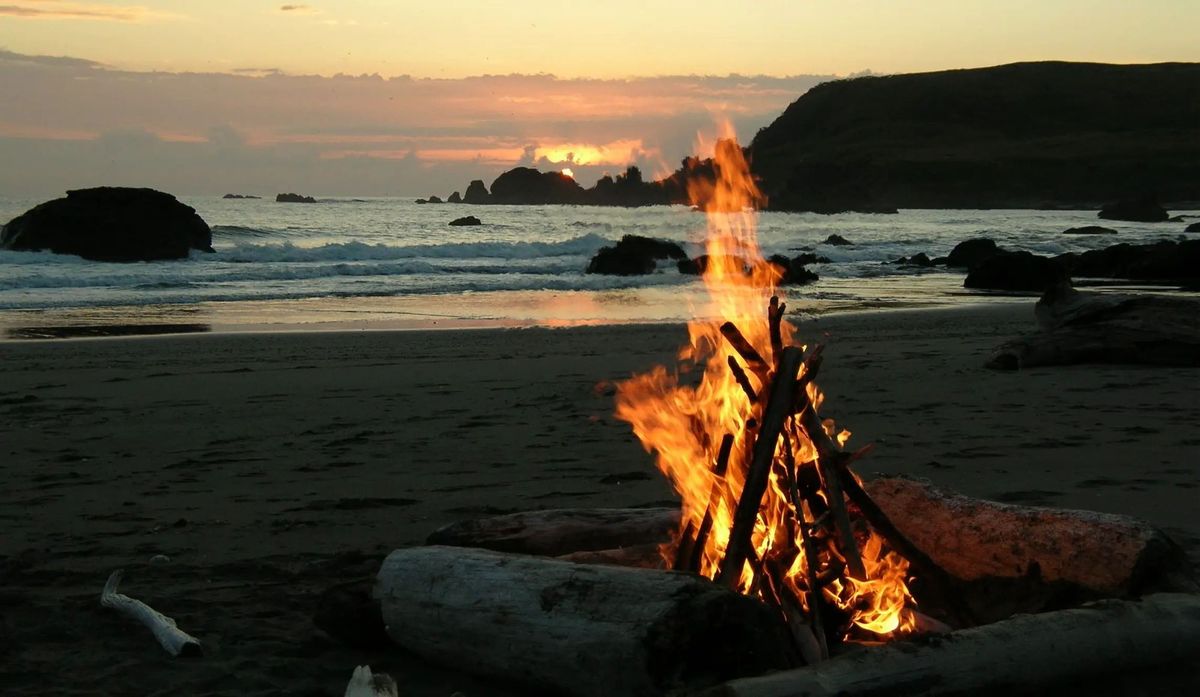
The surf rolled with shattered lumber and battered bodies. Two enormous ships were burning: triple-hulled mammoths driven prow-first into the wet sand, propelled upshore with the deadly inertia of a stampede. Their sails marked them opponents—black and white, clearly distinct from To’mea’s angry red. Men had spilled from the beached vessels and set to killing other men in the waist-deep surf. Blows, blades, chunks of glass and serrated shark teeth rent flesh in an orgy of foam-flecked violence. From our vantage all were naked and bloodsoaked and not one man could be told apart from another. Yet the battle’s tide was clearly pushing the defenders back from the shore break. There weren’t enough To’means, not for all the hundreds landing. Invaders fought their way ashore, moving from waist-deep to knee-deep. Finally their toes gripped bare sand steaming with blood. Keone’s men felt To’mean soil.
Staves led the formation, a step ahead of the torchbearers. He turned to us. Our host steamed in the night air like worked horses and watched him with the same wild eyes.
“Time to lay it down, boys!” he cried with vim. “Put that fuckin’ steel in ‘em!” Those who spoke English cheered and the others followed a moment later. Four young warriors hustled between the assembled troops with crude straw brushes and bowls of red dye which they splashed on our chests. A crimson triangle dripped down the vest buckles towards my waist. I hoped to keep myself otherwise clean.
“Gentlemen, I’ll keep things simple on account of the hour. We hold the beach.” The burning ships lit up the rapiers in his hands. “By sunrise, two thousand men could land. They may not,” he declared.
“Watch your swings in the dark. Look for the red, kill the white. Keep your backs together when you can and look the hell out when you can’t.” Carnage was in the air. A thousand fights into a long and reluctant career of fighting, the nauseating thrill was the same as ever. Staves took a long look overhead where clouds rushed over the stars and half moon. He seemed to get a sign, turned his back to us started to run. Years and lives and everything else leapt out to hang over empty space like the sand his feet kicked up.
To’means and sellswords ran into one mass, a bloody chimera. From our throats emerged a wordless howl. Weapons were out, pumping beneath our chests, their edges slavering. Staves spun his rapiers in tight spirals, keeping his wrists loose. He kept ten yards in front of us, lips drawn back over white teeth, his legs a blur with a seething puddle of shadow about his ankles. The To’means on the beach quaked on the edge of a rout and we struck to deliver them.
Kane war was frenetic, up-and-down, forward-and-back, all with the most brutal weaponry minds and hands could make from the islands’ materials. Fist-sized cowry shells adorned wooden clubs to crush skulls. Black glass blades of all descriptions shredded tissue with cruel serrated gashes. Men would separate into ragged crimson chunks, clinical and naked, struck through with blue veins like butchers’ cuts.
I had only the cutlass and no armor to speak of. One good blow would gut me like a fish, so I sought a partner and found one in the most enormous To’mean of the host. Grey streaked his long beard down the middle but wielded a great slab of polished lumber and moved like a bear. Expertly fitted into the rim were little white triangles: shark’s teeth, viciously serrated and terribly thirsty so close to ocean salt. The man’s first swing sheared his opponent nearly in half; his second sent a whole cadre skittering back bathed in their comrade’s arterial blood. Bare feet slipped on viscera but steadied themselves as sand tried to soak up the horror. He was an iceberg in a quaking sea, smashing his way through lesser floes who broke helplessly on his flanks. I traveled in his wake, slashing opportunistically, catching the legs and arms of men already driven back. I have been and ever will be a poor fighter, so it was enough to fend the invaders off my new friend’s back.
Our opening rush drove the invaders to the shorebreak. Savage combat continued as sea foam came to our knees. A whistling wooden javelin pierced my patron’s thigh and laid him low. Like a stricken bull he fell groaning, three men working together pulling him to safety, so mightily he struggled to stay. I tripped over the sodden carcass of a Red Tiger mercenary, his mail sinking him in the shallows. A dark shape came from my right and so I slashed overhand with my cutlass, catching a spark of firelight before opening a long gash across his chest. His weigh fell into me and his blood gushed down my sword arm. For a coward, this was a stroke of luck. I staggered back from the front line, clutching my elbow like the blood was mine. Men gave harrowed looks as I retreated, thanking their lucky stars to avoid such harm. I reached the rear unmolested, finally winning the safety to watch and breathe.
Staves remained at the head of the pack, waist-deep in surf, fighting two or three at a time. Even slowed and unsteady, he was magnificent. Twin blades were deft as steel hands, parrying away strikes on either side. They could be a shield, crossed before his sneering face to ward off heavy blows. They could be needles—their tips seeking tendons, joints, creases in armor, eyeslats in helms. They were two blades, one blade, even a pair of forceps prising apart defenses. He strew death all over the water, white skin and white teeth gleaming through a haze of blood. I watched from the dunes, appreciating his work and quite happy with my distance from it. I didn’t sail a thousand leagues to die like a dog on the beach.
It seemed like we’d won, at least for the present. Bolstered by our allies still on the sand, the defenders pushed the invaders back. A good many had been killed, the rest huddling in the shadows of their crashed ships. I made my way back down towards the battle, careful to stay clear of the melee but sticking close enough that nobody could accuse me of deserting. The grey wrap clung to me, clammy and cold with seawater. A set jaw kept my teeth from chattering.
There came the scream, LOOK! Keone’s next wave waited two hundred yards out in the water: six boats, eighteen hulls and five hundred howling Kane. Behind the ships, in the distance, were hundreds of torches. Row upon row, wave upon wave, an army of fireflies advanced with the tide. Arrows screamed in, cutting down men from both sides in the water. The shrieks of the freshly wounded overwhelmed the groans of the dying.
“Out! Get the fuck out!” Staves herded everyone upshore. I was already running, grimacing against the shrieks of incoming arrows. Men grabbed planks and battle shields once discarded, pulling them overhead for protection. A canoe’s broken hulk became my bulwark. Suddenly Staves was beside me quick as lightning, taking shelter in the same shadow. He didn’t acknowledge me, just grimaced at the black sky lit dimly orange like over a campfire. The force on the beach was breaking, scattering and retreating up the sand. As the boats bore down on us, hurling spears and launching arrows, ever more of the shore came into their range. To’means fell shrieking like birds.
A hot wind sundered the air, tearing missiles from the sky, discarding their matchsticks over the bloody ground. A rumbling sounded from below the earth, tunneling through my guts and setting the sand to hum like a tuned fork. The catamarans plowed through surf building to a high chop. Staves stood up suddenly, an grin creeping over his face. He extended an arm, windmilled one rapier into a keening blur.
“Stand your ground!” he crowed as arrows fell around us. “This is ancient land.”
I heard no more as his voice was overwhelmed. From over the dunes, hot wind bore an unearthly howl that cracked like thunder over open plains. Not since my most tattered shreds of childhood memory, in the Calamity’s aftermath, could I remember such a noise.
But this was no rumble of distant atomics; it bore the unmistakable mark of a human throat. Arcane language crested a wave of sound, setting loose raw power to rush over us in a flood—whispered suggestions, bitter truths, the fractures in every life. Loves that didn’t want us and friends we let down, who died thinking the same of themselves. The Kane gods made themselves known.
The mercenaries cried out, fleeing or falling to their knees, some left quivering like deer in lamplight. The To’means chanted in their language, the cohort singing loud enough to compete with the wind’s voice. And then the sand shifted. A solid wall of granular rock rose from nothing, as if erected by the spades of a hundred ghostly masons. Twelve feet high and three thick, it suddenly severed the shore from the rest of the bay. But King Keone’s landing ships kept coming, their barnacled hulls of red koa crashing through the surf like shock cavalry. It would take more than wet sand to halt their charge.
Something coalesced from the howling wind, booming and terrible, perfectly pronounced though it wasn’t a human word: “THUUAAHHHTAAAIII!” It carried over the bloody sea, sending up a single wave a dozen feet in height and faster than the others, sliding through them, reforming on the other side, pitching the ships’ bows up in the air and down again. Men fell from gunwales, from masts, spinning like pinwheels when their limbs caught the rigging. With the sound of a gunshot, this breaker slapped into the magic sand wall. The wall quaked but held, launching spray fifty feet in the air and sending the wave back out to sea at seemingly every inch of its previous height. Undaunted, the enemy boats kept coming side-by-side in a solid rank. Their crews kept shooting, brandishing their weapons, screaming in ferocity or in fear. That same awesome call once again over the wind, buoyed by the To’means’ ululating chants: “THUUAAHHHTAAAIII.”
A second wave appeared out at the reef’s hidden edge. Bigger even than the first, traveling from the same spot towards the shore. It took me a moment to understand, to see the two forces converge, to gape at the bell-tolling coordination between them. The incoming wave met its outgoing partner precisely at the catamarans’ midlines. The explosion blew cracked them in half.
A thunderclap buffeted air against my face. Spray flew a hundred feet higher alongside shattered timbers. For a moment everything was quiet and still, debris suspended in the sky so long it might just stay up there. In this moment anything seemed possible. The pieces might fly back together and the masts would right themselves and the pontoons would once again break waves instead of rolling dismembered through them. White-garbed sailors would climb from the sea and take back up their weapons and leave this grisly place. In that moment all those men were still alive. But moments, like stories, end—the planks fall and lungs take on water.
For all the foamy chaos, the beach was silent. Out in the sea men were screaming, thrashing into the surf, stroking for the open ocean before the sea pulled them under. We stood watching and steaming in night air gone suddenly cool. A savage undertow pulled the invaders down and before long the sea was quiet too. Stars shone between plumes of black smoke. King Keone’s fleet waited out past the tides and the reef, its own twinkling constellation near the world’s edge. The sand wall crumbled before my eyes, dampness no longer enough to mortar it.
Men on the beach were weeping. Those lower to the surf took prisoners, finished those too badly wounded and bore the rest away. “Gods be praised,” Colonel Staves declared with a clap on my shoulder, rose in his cheeks. “Gods be fuckin’ praised.” He walked off laughing, swinging his arms and taking in the beach like a child wandering fairgrounds.
The bay’s arms curved gently away to the east and west. Uphill to the southeast, long grass climbed up heaps of sand glittering like white marble under the moon. The blades themselves were silver and ghostly, licking at the waists of armed men. Torches turned them all to silhouettes, but up there far from the field waited at least a score of soldiers. A conch hooted from upshore: one long flat call, followed by a second ending in a somnolent trill.
The To’means on the beach spoke in whispers amongst themselves. Mercenaries squatted on the sand, cleaned their weapons and took the toll of their rent armor as the heralded troops descended. They marched ceremoniously onto the bloodied field: Koali’i, elite troops for the ruling Speakers, bearing shields and spears and armor tied together from fine wooden slats. Crested helmets made from large gourds left two ovoid ports to look through. A man and a woman led the guards, unarmed and unarmored. He was tall and striking, his face scored with middle age and his shoulders with a mosaic of scars and tattoos. Green leaves garlanded his head and hung from his shoulders; in one hand he held a conch.
She was long-legged and lean, wrapped in a red cloak with a white cowl like a bird’s beak. In daylight I’d have seen her face, but now the torches threw her cowl’s shadows across it. She wore pride like iron plates over her loose finery. The To’means shrunk away like she carried some palpable aura. Sellswords developed a sudden herding instinct and clustered together down near the waterfront. None had the gumption to stand before a High Speaker of Ku.
She stopped and her herald took a few more steps. He spread his arms and lifted them, one great paw palming the conch. Taking a great breath, he began to bellow. His speech came first in the Kane language and I tried to map out the hard sounds, the bright vowels. Friar Waldman had known the tongue and described its basics: kept simple by the people, he said, because it was never written. When the herald was done he repeated the address in precise English. “Behold the High Speaker Ienith Pele’iwa, She Who Cracks The Earth. By her efforts tonight, the shores of To’mea remain free of invaders’ stain. The Speaker honors and guards your lives. All glory and praise to the Gods, and to the Speakers who carry their words. Glory to the Mighty Ku and the gifts that flow from His Mouth!”
All knees were in the sand and plenty of foreheads too. The display on the beach was beyond anything I’d seen in a long life of adventure. Colonel Staves was the only soldier on that strand unafraid. He tromped towards the High Speaker and her herald, boots squishing resolutely through the sand. When he drew close the herald took a step to bar his way. The Colonel touched his knee in the sand, sprang back to his feet and—having paid that cursory tribute—passed the taller man by. He drew close to the Speaker, exchanged words and nodded understanding. They’d spoken for a minute when, for absolutely no reason apparent, she reached out a finger and pointed. I’d taken a knee some thirty yards away to blend in with the rest and now felt my throat tighten with horror. She was pointing at me.
It couldn’t be. It made no sense. I watched her innocently though her aim was plain to everyone else. My skin burned with the hundreds of eyes moving over me. “The haole there, in grey,” she stated flatly. There could be no mistaking her intent, so I stood up to approach this titan made flesh. A narrow channel through the cloth showed dark almond-shaped eyes. They were mesmerizing, black with flames at their hearts. She broke my gaze to speak once more with Staves and the herald. When I got to them my heart was racing. I didn’t want to be chosen, to have my freedom taken and my plans derailed. But things crop up. If you want to go north through a dark forest, you don’t abandon the path just because it turns from north. At the very least, nowhere on To’mea was safer than with the Lady Ienith. I reached her and stood with eyes respectfully downcast. The High Speaker never addressed me directly, just turned with a red flash and strode back up the dunes. Her herald followed and so did the Koali’i.
Staves wrapped a hand around the back of my neck. His fingers were cold steel. “Her Ladyship’s got the grand idea to take you along, Ashur.” He pushed me after the retinue, making sure it hurt. “You say one word out of line…”
“Sir, I don’t understand,” I deployed my best wheedling voice.
“The fuck you don’t. Had you pegged as a clever one from the start and now I know it.”
He gave me another push in the back. I hustled after the High Speaker while the Colonel stalked surly behind. “Sir, about my pack—“
“It’ll meet you in the morning.”
“How will they know which one?”
“They’ll know,” his lip curled.
“Why’d she care the least bit about me? I’ve no clue, truly.”
“I’ve no clue, truly,” he parroted back to me. “If I’ve got one clue to the Lady’s thinking, then strike me dumb, but whatever your gambit, know she’s seen through it.”
Above the beach we met a dozen ox-drawn carts. Horses were rare in the islands and all but absent from To’mea, disdaining her harsh volcanic plains. Oxen and cattle were common on the pastures, pigs and goats and chickens in the pens. Easier to feed, more use for the land, better eating when at last they couldn’t work. I couldn’t see the High Speaker and found myself bundled into the rearmost cart. Staves went further up in the train, leaving me with three Koali’i who stood silent leaning on their spears.
The carts rumbled for just a few hundred yards before turning abruptly north. We climbed from grasses and dry stones into short trees. Two torches burned from the shoulders of each cart, lighting the half-naked men who clucked and switched at the oxen.
In time even the stars were devoured, the sky going dark as the trees grew tall. You could still see the ocean between shifting trunks, marked by a silver spear of moonlight that anchored my own personal compass as we made turn after turn up switchbacks. Battle’s sweat dried on my body. The crystals stung my eyelids as I scraped them away. It was getting cold and soon the jungle shrouded out any view of the water. All that remained were sputtering candles down the hills behind: from the dry plain’s village, the mercenary camp. I imagined the scene: men lolling about in their blood-crusted finery, eating and drinking and basking in the glow of victory. For my part, the cart’s gentle jostle and the hollow drag of fading adrenaline were a sedative with the slow rhythmic breaths of oxen and the puffs of steam from their nostrils. I fell asleep climbing into the clouds.