Speaker for the Gods, week 5
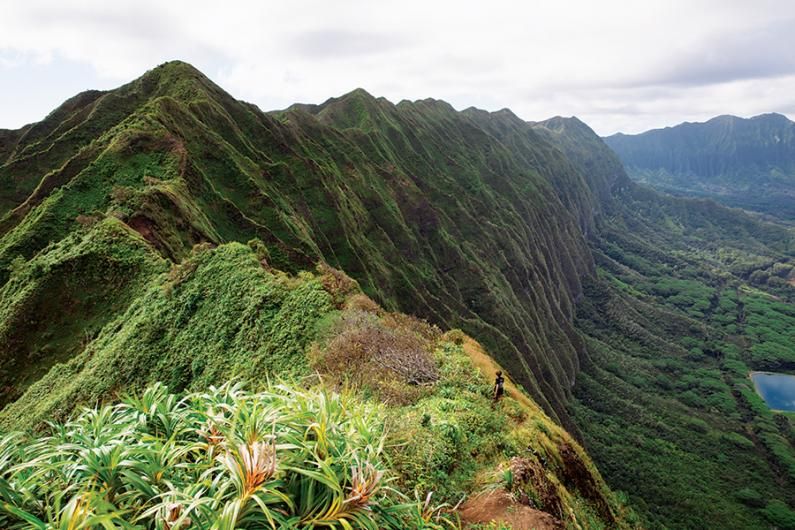
The Ridgeback Climb
The trail ran uphill through a patch of dry trees burned black in some not-too-recent fire. The afternoon’s accumulated heat chewed from the ground through the soles of my boots.
Examining the satchel the Higher Speaker had given me, I found dried fish and wads of sticky rice secured in waxy green leaves. Water too, though the falls overhead suggested it’d be easy to find. Needle and thread, rolls of soft kapa bandages and at last a gorgeous machete. I don’t feel too strongly about weapons, so if I called one “gorgeous” it made an impression. Solid steel, the kind you didn’t see much anywhere and certainly not on To’mea. On each face was etched a whale, arching its back and splaying out enormous oar-like flippers, its throat was striated with long, graceful lines etched in the steel. Exquisite craftsmanship; exactly the tool I’d need hacking through the jungle, though it pained me to think of all the dirty work it was about to do, the scratches and nicks and streaks of sap it would endure. It rendered my cutlass dead weight, so I ditched the inferior weapon trailside in a hollowed trunk.
The sunset wouldn’t be for a few hours—this far south it was about the same year round—but Mau Pu’eo loomed in the west and already its shadow crept advanced across the forest. Trees and brush no taller than eight feet lined the trail, bark cracked and callused from living in such dry dirt. Their leaves were bright green, defying the heat to show late spring’s color. A few bright red fruit dangled from bushes and many more rotted sickly sweet beneath my boots. Bird-pecked remains sagged black and dead on withered stalks, so they were likely safe to eat. I wasn’t yet hungry enough to risk it and kept climbing, striding briskly uphill with fresh legs.
I crested the first ridge and could finally make out Hunakai Harbor, far below to my south. Bonfires sent up white smoke that by morning would likely burn black with pitch and corpse tallow. Dark hulls and white sails crowded the quays: a hundred ships, simple canoes and twin-hulled catamarans lined up over the defenders’ sunken bones. Sunset painted blanks of clouds out over the ocean.
The trail was rough and winding, but easy to follow. Runoff from past rains had cut long shallow trenches in the dirt. Wanting to clear the steepest portion while some Sun remained, I grunted uphill beneath the pack. The crest of the hill was so steep I nearly fell backwards, unbalanced by the pack, and found myself pulling on the trunks of emaciated trees for support. At the top I took a breather and dusted the flakes of dry bark off my palms. Looking around, I surveyed the sheer west-to-east ridge. Eventually it joined a larger finger of mountains: the body of the Ho’o’aui, crawling north into bone grey clouds. The last of the Sun threw shadows like veils over the steep ravines. To the south, down the brushy hills and across the great dry plain, the battle for Hunakai Harbor had begun.
With the benefit of a proper martial education I might have stayed the whole night on that ridge, watching and learning. As it stood I could only make out the most basic battle lines. The masses converged as I made my way across the ridgetop, cool dusk winds kicking up across my path. When men began to die, as they must have once the lines met, there was no sound. The battles of my youth, fought with guns and artillery, were long gone. The only living sounds were birds that squawked and squabbled through the dimming sky.
A hundred feet down and two hundred feet up I marched, repeated for the next two miles until there moss sprouted on the tree trunks. Sweat leaked from my temples for the breeze to wick away, soaked the pits of my shirt. I could begin to smell myself. Fires were burning in the harbor. Then a sound came, drowning out the birds, riding for miles on the wind, building in strength with every breeze until the sky seemed to crackle. It was Ienith’s voice, transmuted by unnatural force into hai’oleo. Goose pimples blossomed over my arms despite the sultry evening. This wasn’t Ienith’s spell from the beach, which had come in long roaring draughts. This was a chant of sorts, slick consonants twisting under a pall of tidal noise. They rolled around on the breeze, screaming ever louder over the ridge.
The ground was humming. Pulses ran through the soil in time with the High Speaker’s cadence. They flowed from the harbor—I could see the brush on the south slope roll in ranks of waves. Dashing along the path, both hands on the satchel to keep it from bouncing too badly, I cleared the ridge’s exposed spine before the spell reached its full deafening strength. My knees hit the dirt and my arms encircled a tree to brace against the storm. From sonic structures roiling the air like gnat clouds, hai’oleo coalesced into a howling surakasurakaSURAKASURAKASURAKA.
The sea burst into foam, disrupted so suddenly and at a scale so massive it turned my stomach to behold. A raging cauldron brewed in the water, spinning up like a mile-long turbine just beyond Hunakai’s red piers. The entire island seemed to shake, loose stones and soil running like water down the ridge’s flanks. Plumes of dust rose from the darkened battle plain. I wondered what was happening below, imagined the terror gripping invader and defender alike. Did the To’means flee screaming, as I’d have done, or did they plant their shields in the quaking earth and trust in Ku’s deliverance?
However tempered their inner steel, few could have steeled themselves for what followed. The piers began to warp, ripped by tidal rage inexorably away from the land for the sea to claim. Water swept up two-ton stones like a gambler raking in a pot, driving them gleefully together, grinding ships and men to paste and sending up deep cracking sounds to echo off the hills. Ienith’s words faded from the air; the spell had set so much water in motion that the chaos raged on its own. The worst quaking was over and it felt safe to stand. Over the next ten minutes, my stomach churned as the maelstrom devoured Hunakai Harbor and sunk its ruin to the sea floor. The water wound down slowly—soon it would be too dark to see the debris. Combat was concluded, though I couldn’t name the victor. It seemed hai’oleo should win any battle, but the invaders had already slain a High Speaker and landed despite Ku’s power. Keone was moving east, splitting the To’mean forces and positioning himself to destroy them piecemeal. He had a plan and it seemed the To’means were playing catch-up.
I hiked nearly two more miles before deciding it was too dark to continue. Campfires twinkled to life across the plains below. With the half moon winking low in the sky, I cleared the last ridge and finally joined the mountains’ heavy slopes. This was a proper forest with tall trees, knee-high undergrowth and a carpet of damp rotten leaves on the trail. I smelled the now-familiar mix of sweet flowers and acrid decay. The woods would be safe without large predators, but I didn’t want to fall in a ravine and besides there was nothing to make me rush through the night.
I gathered the driest leaves I could find into a soft heap. The cool night breeze was like angels’ kisses after such a sweaty afternoon. Stars waited above by the millions, fearsome bright since I hadn’t smothered them with fire. My bones sighed like an old house as I stretched out on the pungent cushion. It was a beautiful evening on a speck of an island in a vast deep sea, and I was happy to be alive.
Rain woke me in the dead of night with a hard cold drop directly in my right eye. It was pitch black—clouds overwrote the cosmos and their progeny pummeled my face. Dragging my pack on the ground with one hand, digging at my occluded eye with the other, I scrambled out of the clearing to find shelter under a tree. It was a pine, big and broad, its sandpaper trunk naked for its first five feet before long limbs burst into a bushy halo. They were different from the pines I knew, their needles long, scaly tubes a quarter-inch thick and five inches long. A thick carpet of water came down outside the halo’s reach, but the ground beneath me stayed dry. The odd drip made it through the web above, and I made a note to seek these trees out in the future. It was stupid to sleep in the open anyway, tropical showers being what they were.
The downpour stopped as suddenly as it came. I’d spent no more than five minutes under the tree. Outside its umbrella, plants were wet but the soil hadn’t yet soaked through. It would be hours before the Sun, judging by the dead black horizons. The shower’s shock had me too agitated to sleep, so I used my hands to clear a patch of ground. Figuring rain would return, I stayed under cover while building my fire. My flints were in the pack and the machete served for steel. The pine needles were tinder, and I kept the flame low so the branches overhead wouldn’t burn. Sitting cross-legged with my back against the tree trunk, I dug Waldman’s tome from the pack. My little fire cast enough light to read by.
“This town just southward and downhill from Hoku’e had settled for the night. I passed thatched huts on the periphery, bound for the largest building near the center. It was utterly different from the others and could mostly properly be described as in the Western style. Kane structures are typified by lava stone foundations, wood platforms and roofs of grass, but this was unmistakably built by white men. Two stories in height and wood down to the foundation—unthinkable for Kane architects, who build past the first floor with stone or stilts to ward off termites—it was boxy and simple, its length about three times its width. Clapboard walls, clean and white, square windows and doors, genuine glass in the former. A dark tarred roof was high-pitched as though its architect expected snow, and a white picket fence enclosed a trim lawn of thick-bladed grass. Lights burned in some of the first-floor windows, so I pushed through the fence’s hinged gate and simply knocked on the door.
“I expected a white man to open it, but was shocked to see him in holy cloth: heavy black cotton with white trimmings and a silver crucifix about his neck. Being equally astonished for what I suspect were the same reasons, the man bid me welcome and called me in immediately. The interior was well-appointed but not ostentatious: heavy tables with inkwells, bookshelves against the walls, and kukui oil lamps all caught my eye at a glance. My host introduced himself: Ephrem Rider, a Deacon of the Clan of Luther. Opinions of the Clan will differ between my brothers, but personally I have always considered their various heresies both well-intentioned and essentially harmless. I named my own sect and was pleased to see recognition in his face, though the Deacon confessed he knew us only by distant reputation. Which mattered not a bit; so far from the heart of Christendom and in proximity to pagan Speakers, two Godly men were the most natural of friends.
“Hale Hau’oli was the town, he said, and I had been fortunate to stumble upon the Clan’s local school. For the reader ignorant of their aims, the Clan builds mission schools in keeping with the teachings of Saint Luther Gutenberg As Luther set ink to paper and hammered the very first press-printed letters onto the door of his church, so they consider God’s first aim the spreading of knowledge. This is nonsense, of course—learning, while a worthy pursuit, can by no means be called inherently holy under even the most liberal Scriptural interpretation—but in fairness it is pragmatically harmless nonsense, leading to healthy prescriptions like reading and writing. Others have inflicted far worse atrocities on the Scriptures.
“The Kane Islands were a natural setting for the Clan of Luther, their people as warm and welcoming as the climate, the rate of literacy approaching zero as the Kane language is utterly unwritten. When I describe a word to the reader, it is rendered in English script just as my ears hear it, but no Kane viewing that script could be expected to recognize his own tongue. So the Clanners and their descendants spread across the archipelago, building schools and spreading God’s printed word. While so common on other islands that a man can speak English nearly anywhere and have it understood, To’mea’s ruling priesthood took a dimmer view of their work. The island’s rulers turned a blind eye, Ephrem explained, and Hale Hau’oli’s Speakers were generally tolerant, but some slight of religious protocol (now decades past and barely remembered) had led to a proclamation: no new schools could be built on the island. Though those already standing could remain, he concluded, attrition had slowly driven away the Deacons and the speaking or reading of English was a rare skill amongst To’means in those days. I am sad to report that with the passage of time this circumstance is likely only to worsen.
“I ate a late supper of cold rice and goat meat furnished by the Deacon’s wife, a Kane woman. Her two small children were asleep upstairs, dreaming in dormitory cots alongside a dozen local orphans who also lived at the school. Ephrem seemed very pleased to see an outsider, immensely and in my humble view justifiably proud of the school he ran. It was founded, he recounted in far more detail than I will render here, by a much older man some generations years prior. Ephrem had taken over from one man, who had taken over from another, and so on until time grew foggy. New blood would come from the mainland, every few decades, and Ephrem had been on To’mea for fourteen. The last Deacon was dead, and his mixed-blood son Kai was a young man of the cloth currently in tutelage.
“Between Deacon Rider, Mrs. Rider and their charge, three people worked to maintain the grounds and teach the children. How were they provisioned, I inquired? By the town Speaker, he explained, as compensation for the orphans they took in. The Kane are remarkably generous in caring for their least fortunate young—the sight of begging children is a blessedly rare one in the islands—but they were nonetheless glad to have someone shouldering the burden even if those volunteers were the derisively-named ‘haoles.’ It is a common arrangement for Clanners the world over: a way for the Deacons to prejudice the ruling priests in their favor. If they give parents a few hours’ respite from their children and teach the little ones good Christian discipline, so much the better. The entire Lutherist organization relies on good relations with the heathens they serve, and compromise with the local culture is a necessary part of a Deacon’s daily work.
“The local Speakers asked one thing in return: the surrender of any orphans destined for Speaking themselves. The priests had their own tests of potential, Ephrem explained. How, I inquired, could he simply deliver innocent children to heathen hands? In the eyes of the Clan, he explained, those who became Speakers were thoroughly educated in their own fashion: imbued with the meticulous oral knowledge of their sect. It was a curious compromise and one he seemed queasy explaining, so as a courteous guest I let the matter pass. Once I was done eating, Ephrem left the bowl to his wife and led me to a spare bedroom she’d prepared.
“In the morning I woke to children’s chatter and the rumble of their feet on the floorboards. I took a walk around town rather than intrude on morning classes, enjoying the mix of morning sun and fresh dew. Hale Hau’oli was larger by plot than Noio Koha, but the mountain town’s high walls and multi-story buildings marked it clearly the richer. In fact, despite its position of pride at Hoku’e’s foot, this farming village seemed remarkably poor. Lines of carts and pilgrims headed for the capitol passed uphill through the village in the mornings and downhill in the evenings, empty and exhausted, but only a few cowries were ever spent in Hale Hau’oli. For what could this place really offer? Too dry for good farming, too removed from the sea for fishing, it scraped an existence off cattle that grazed on the broad volcanic slopes. Even the water these people drank was sent down from the capitol, as a sort of charity. Toxins still seeped through the ground at this altitude and the groundwater wasn’t suitable for drinking, but the wells of Hoku’e evidently delved deep enough to reach a clean aquifer.
“If the city’s wells are impressive, its walls are wonders of the modern world. Thirty feet high and studded with taller parapets, they run around all of Hoku’e like a conch’s thickly calcified shell. The city stretches up to Mauna ‘Ele’s crater lip, the Grand Monastery’s spectacular edifice towering over the caldera. The wall blocked out my vision of the lowest buildings, but above sprawled a true stone city of the type which has all but disappeared from the world. The ruins of the old Kane cities—what must have been rank upon rank of shining glass and steel—were more completely consumed by the ravenous jungle than their temperate counterparts. Metals are scarce, as noted in the second chapter (“Concerning the Provident Natural Resources of To’mea and its Waters”), and tools to cut stone even more so. The natural basalt is a poor building material: absorbent of the Sun’s heat, heavy, brittle and hard to cut cleanly. It can be fractured and wedged together with intuition; the Kane excel at this, and their masons are closer to artists than artisans. Seawalls and piers take tremendous time to construct, the masons pondering for hours the placement of every stone. But like Hoku’e’s wall, once constructed these structures can only be broken by tremendous force.
“Returning to the school, I found chickens pecking in the yard. Ephrem’s wife worked in the kitchen, letting brown-shelled eggs boil in a pot over the fire while she churned a great steaming cauldron of corn mash. The students entered in single file—nearly forty of them, far more than the dormitory could have taken in—and took seats at one of several long tables in an expansive but low-ceilinged mess hall, doing their best not to stare at the new white man for they’d been taught it was rude. Deacon Rider introduced me and invited an account of my order; I demurred, remembering my own youthful inattention whenever the Master Librarian lectured during meals. Food was served by the Deacon’s wife, and his apprentice Kai. The children fell on it greedily and chattered in Kane, while I sat beside the Deacon and asked about Hoku’e. Entry is forbidden to non-Kane, they replied. Native To’means may only cross the gates during daylight hours on pilgrimage to the Monastery and they must leave the same gates by dusk. Only Speakers, and the hosts of Kane who serve them, have true residency: soldiers, messengers, attendants, advisors, scholars, and a host of servants from cooks to garbage haulers. Living in the City of Stars was an incredible honor; even residing in sight of its hallowed walls a privilege.
“To enter the gates as a white man was impossible, Ephrem explained. He had never tried, his position being delicate enough and the school his highest priority. I expressed my disappointment, and my desire to see the Monastery myself in order to describe its workings for my book. Ephrem praised me then, at mortifying length, for adding to the wealth of human knowledge. The children endured it, finished their meals and sat fidgeting until everyone was finished. At a signal from Ephrem, they bolted outdoors. Most went to help their fathers in the field or their mothers at home; the boarders got to work cleaning up from the meal, Kai calling out directions and keeping the smallest away from the hot coals. Ephrem beckoned me and we went outside together. He led me to the Speaker’s home at the center of the village.
“Hale Hau’oli’s Speaker was, as it turned out, close to the Deacon. The man spoke clear English, albeit in the jovial pidgin common to Kane. He had grown up in the town, having studied under Ephrem’s predecessor before his induction into the Speakerage. I begged the Speaker for admission into Hoku’e and explained my innocent aims, but he could only grimace sadly and shake his head. Impossible, he said, even with a Speaker’s sponsorship.
“I asked him about his role in the village and his perch in the Speakerage. He was happy to lecture at length on the topic, and Ephrem eventually left us alone while he went to prepare his afternoon lecture. The Speakerage’s hierarchical structure had been explained to me before, but only in a rough mix of English and Kane, and never by a man legitimately trained in what the To’means dub hai’oleo. First, the Speaker—Noa Pauahi, born Noalani and dubbed ‘consumed by fire.’ The name, he stressed, was over-dramatic. With tongue clicks and snaps of his fingers, Noa conjured flame for me, and set curious glowing orbs to drifting about the room. I worried they’d ignite the thatching, but instead they bumped benignly against it like bubbles. Such tricks lit the inside of the great Kane fortresses, he assured me. Noa’s own talents were put to use clearing old pastureland and light the town’s various annual festivals. He was more the town’s grandfather than its sorcerous ruler, and was called ‘Kuku’ by any true son of Hale Hau’oli.
“To’mea is ruled by three tiered cadres of priests: at the pyramid’s base, young Speakers are appointed either to lead villages or serve as the army’s officer corps. High Speakers sit in the middle, as generals or regional lords, promoted by their fellows based on their magical abilities. Noa was aged but still of the lowest rank; he claimed he hadn’t the talent nor ambition for advancement. At the apex of To’mean society roosts a three-man council of Grand Speakers—the Mouth of Ku, elevated by a secret council of High Speakers. If appointment to High Speaker was the product of talent, elevation to Grand Speaker came through political guile and maneuvering. Speaker Noa stated he was a simple man, happy to lead the village that raised him and happy to stay out of politics. He missed only the comforts of a family—a wife and children to fill his home. Such things were impossible, he said. “Impossible,” I asked in English, “or forbidden?” I knew the former word in Kane, not the latter, and cannot say whether or how they differ. But he repeated the same word, and I didn’t wish to press my gracious host on such a sensitive topic.
“I greatly admired Noa Pauahi, seeing in him the best traits of the simple parish priest—that humble, patient approach to each day’s challenges. I recounted to the village Speaker the Lord’s own refusal to grip Earthly power and the righteousness he revealed in so doing. Noa seemed pleased at the association, and offered me his tiny home’s hospitality as Kane so often did. At this I demurred, suggesting Ephrem’s wife might be offended. Speaker Noa said he understood, pulled me into a manly hug and wished my quest the best of fortune. He apologized for his lack of aid, and I assured him his advice would aid me a great deal.
“Kai greeted me on my return to the school, scattering dry corn on the ground for the chickens. I expected a momentary exchange of pleasantries, but instead he stopped me with a raised hand and drew in close to speak under his breath. He could, he claimed, get me through Hoku’e’s gates. As a Kane himself, it could be done. The young man wouldn’t elaborate, but simply urged me to meet him the next morning. We would travel separately, meeting off the road just after dawn to reach the gates when they first opened. Most importantly, I wasn’t to breathe a word to the Deacon. I was to take no gear and no pack, as we’d return before that day was out and their removal would only arouse suspicion. Marveling at my luck and willing to try anything short of violence to breach the City of Stars, I swore to the lad my trust and faith. Ephrem was better off oblivious, for his own protection and that of his academy.”