Speaker for the Gods, week 6
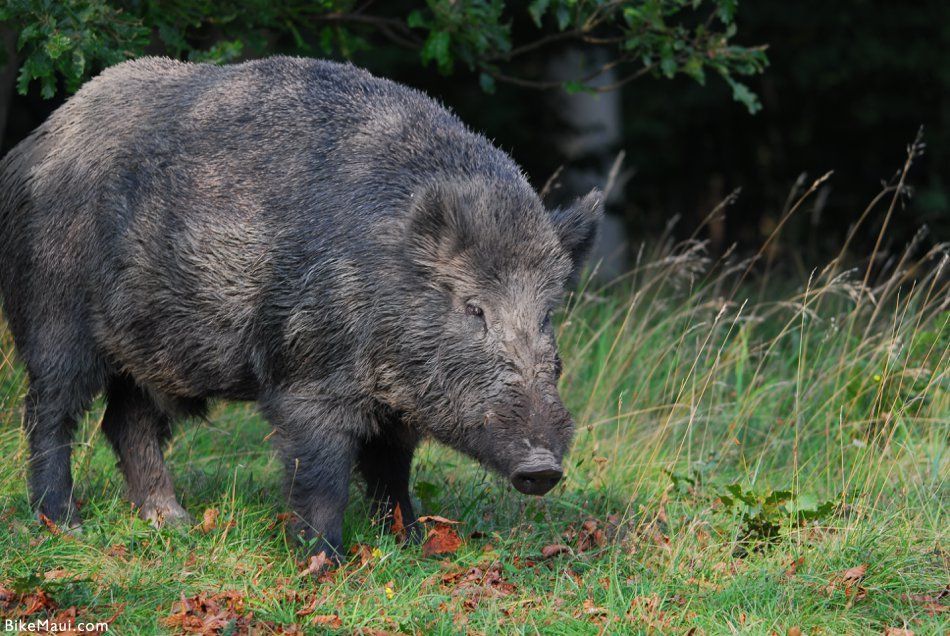
Pua'a
Light came sooner than I’d expected, bird calls starting an hour before to omen the dawn. I closed the Friar’s book, wrapped it in a shirt and pushed it down deep in the pack to caulk it against the rain waiting in dark grey clouds above. Nimbus towers clung to the mountaintops like they feared the sea. The peaks were three thousand feet; eons of running water had ground them down from ten, leaving them sheer and craggy. Vegetation clung to every square inch of those vertical plunges, broken up only by frosty banks of morning mist.
I stood, swung the satchel over one shoulder and stretched the kinks out of my back before resuming my hike. The path continued northeast through the forest, up the ridge I’d joined the night before. Pines grew more numerous until they were the only trees around, suffocating the undergrowth under a blanket of shade and discarded brown needles. With the Sun blocked out, the air stayed cool and mild. The morning’s avian squawks settled to merry chirps amidst whispers of wind. Little brown sparrows hopped their way across the ground, rooted for insects between the needles. I walked for nearly two hours as the grade flattened and the pines swelled, demanding ever more space between their trunks. Waist-high shrubs smelling of pepper grew in the sunny islands between them, where tiny insects drifted like dust motes.
Finally I reached the apex, the ridge of the Ho’o’aui spine where the road forked. North was uphill and south downhill, a treacherously steep slope falling away to the east. A shelf of earth jutted thirty yards out from the mountainside: an ancient volcanic cyst now worn to a sheer cliff. I walked out on the shelf, feeling secure since old trees had seen fit to colonize it. Below was a high-walled valley carpeted in thick jungle, tapering at the north end into a crotch of mountains. The forest to the south was broken by only one thing: the clear-cut orange expanse of a road running west to east across the valley’s mouth. This was the artery Ienith mentioned and at the moment it was clogged by the mass of a mighty army. The force was miles downfield, so far advanced in its eastern march I could see only the rearguard. The To’mean army could never have marched so far, so soon after battle. This was the force Ienith had mentioned, pushing eastward with their king having left only a detachment to guard Hunakai Harbor.
I rested a moment on that shelf, leaning on a tree, pulling at a waterskin as the procession shrank to a dark blot. Keone’s sheer numbers forced his men to pack along the road in tight clusters of infantry broken up by supply carts—most pulled by crews of men, though a few by oxen. With only a few hours and the fleet of ships I’d seen destroyed at Hunakai, the invaders couldn’t have brought much livestock ashore. I mulled over what this portended for the days to come. Ienith worried about a northward push into the mountains, but Keone seemed to have skipped this valley entirely. The northward ridge I followed bent towards the largest mass of Ho’o’aui mountains and I figured to follow it all the way up. From there I’d skirt over the tops of the valleys and head for Noio Koha, the large high-walled settlement far east Waldman’s account had mentioned. It should be safer than most anywhere else, though like the Friar my quest would force eventually drive me from the mountains. Los Angeles was a ship, I reasoned; ships are kept near the sea.
Buoyed by rest and fresh resolve, I attacked the north trail. A walking stick would have eased my way but the only limbs long enough were stuck to pitchy pines. About a mile along I encountered a large grey stone trailside, carved with Kane petroglyphs. Leaning in close and sweeping off moss with my palm, I noted three human figures: two large and one small, all chiseled in simple straight strokes. The large people were holding the small person aloft over their heads, and all three had little symbols gouged into their chests: three short hash marks intersecting at a central point to form a kind of six-pointed star. It was clearly meant to be a waystone, but aside from the hint of a family the message was inscrutable. Perhaps this heralded a village up the road?
Though it hadn’t rained since the last evening’s quick shower, everything was damp. The muddy ground sucked at my boots. Clouds rolled overhead, brought close by altitude and driven by breeze. Ferns and undergrowth dominated before long, happier than the now-absent pines in the building moisture. To’mea’s mountains were cool and mild, more to my taste than her desert plains. Life abounded—plants and birds and lightning-quick green lizards the length of my longest finger. I kept a quick pace, sweat from the day’s labor growing clammy on my neck, until eventually I found myself so high the fog swallowed me whole. A steady wind blew it across the trail like surf foam. I stopped once to rest, stretch my legs and eat the two bricks of sweet cornbread in my satchel. Beyond the clouds, the Sun was a wan white disc descending feebly into afternoon.
Something rustled in the undergrowth—crunching, a brushing of leaves at a steady pace. I drew the machete, swung the satchel around to my back and held the weapon at gut level with both hands. Advancing over a wide stance, eyes straining to see through the mist, I heard the noise stop and then start again. In most woods I’d worry about a bear or wildcat, but not on these islands. I hoped for friendly To’means or anything else that’d let me out of a fight—even a single enemy scout would be a stiff opponent. I took two quick hacks at the air before me to get the weapon’s heft in my hands and hot blood in my veins. My palms pulsed against the hilt as a form accreted from the fog. A hulking shadow, swaying and venting steam for breath. A shriek pierced the air, so shrill and loud it froze my blood while fire leapt in my gut. A wild boar emerged—shuffling into clear view on wood-strong haunches, shoulders like machined pistons, knifelike tusks caked in earth. Four hundred pounds if he weighed an ounce.
It was those tusks my eyes fixed on, thick as spearhafts under the grime, jutting ten inches clear of his mouth. Drool ran their length and dripped to the ground, the foam already striped with ribbons of blood. I met his eyes and saw their pupils opened to dead black, the unsteady orbs showing flashes of white at their edges. He tried to focus on me but something raged like poison through his brain. I backed up, seeking out each step carefully with my boot heels to keep from tripping. That sudden move alone would make him charge. So fearsome were the tusks and so furious the eyes that it took me a moment to notice his wounds. The bloody drool had been my first clue—he was hurt terribly, blood pumping from ragged gashes in his flanks and one cheek hanging like a torn sail. A gaping hole in his belly let protrude a single loop of grey intestine. I retreated another step and the boar advanced, wheezing with agony between his teeth.
I backed up faster in response and cast about for a tree to climb. Dread’s cold sweat pooled at the base of my back. For all the growth around, there were only low ferns or towering trees without any use for low branches under the jungle canopy. Neither would do me any good, but I spotted one option: a single tree with a limb low enough to climb, further than I’d like but close enough to show its red bark through the mist. I leaned to my right to let the satchel slide down my shoulder and smoothly released one hand from the blade to let the straps fall off my wrist. The beast kept coming as I backed my way towards the red tree. In his rage he didn’t even bothering to sniff at the food stored in the white bag. He sought only violence through a mask of blinding pain. There’d be no peace with the beast. It was time to run.
I crouched, coiled, stuck my boot hard in the wet black earth and whirled to face the red tree. That first step started my sprint, hard and low with eyes on the ground looking for any roots to snare me. I heard the boar’s squeal at my third step: a cry of rage, despair, incredulity and pain enough to fill books of poetry. He was coming, carving through the brush like a tuna in open sea. I was fast but couldn’t outrun him even with my head start. A quick glance over my shoulder—SHIT—told me I could make the tree now twenty feet out. But the boar would split me open in the seconds I’d need to climb it. There wasn’t enough time to pull this off. Flight being exhausted, I faced only one solution. Pulling up, I set my right foot to slow myself and turned back to face the boar. Momentum carried my body weight past the plant foot so I could get my left leg back and into a crouch brandishing steel. Adrenaline slowed the world.
Four hundred pounds of howling fury descended with his twin lances low, aimed straight at my gut. His rough coat was matted by blood and dirt into quills quaking with every stride. Pink slobber flew from the tusks I’d have to avoid; severed fascia bulged in the wounded gut I’d try to hit. Cocking the machete up over my left shoulder, I abruptly slid right with two quick steps. He was so fucking close, all pig-stink and blood and hate. With my body already going right, I threw every bit of strength into a low sweeping left-to-right cleave. The machete slashed through a few low leaves and up before I felt it connect. The beast’s shoulder hit mine and the impact slammed me right into the ground. My breath came out in a whoof, my cheek struck mud and damp leaves flew everywhere as the immortal Ashur went sprawling on his face. The boar was past me already, still running and now screaming worse than ever. Blood was everywhere, running down the blade and over my hands. I could feel more, hot and sticky, spattered on my legs. Rolling over quickly to my back, I saw the boar staggering. His belly hung open, the pink hole now a hideous fissure gushing blood and worse. My machete had found its mark, as the best-made weapons seem to do even in amateur hands. The pig limped off in retreat, his wheezing more tired now than pained, dragging his guts in a gruesome swath over the ferns.
I planted a palm in the dirt and got most of the way to my feet before buckling to the ground with a sob of agony. My left leg was on fire, a screaming pain that throbbed and built with every heartbeat. Clutching both hands to the thigh and hissing between my teeth, I rolled to my back and looked down dreading what I’d see. There was a ragged hole in my leg, a full inch wide and pouring blood. With one swipe of his snout the pig had cut gouged a ragged hole six inches above the knee. Laying back and bonking my head against the ground as a desperate distraction, I let out a long scream so loud it echoed back from the forest canopy. Overhead, the trees were blurred and doubled; I fought the pain clouding my head and willed them back to their single selves. Cold seeped through the damp earth into my back, making me shiver with chill and shock.
I pulled myself to a sitting position against the same red tree I’d sought to climb. It would be some use at least. My hands stayed around the wound, clenched and white, applying pressure like an iron vice though they were half numb. The wound was deep, but I took solace in the blood streaming out dark rather than bright cherry red. I’ve seen men bleed out in two minutes from the wrong leg wound, but this was lucky. The boar’s tusk had plunged in with his charge and released with my roll, tearing a long gash on its way out but missing the big artery. In a world of tragedies and suffering, I told myself, this wasn’t so bad. I’d seen worse wounds, I told myself, many times. I would, I told myself, live through the day’s remnants and all of the night. Beyond that, who ever knew? Any one of us could die tomorrow.
Ienith’s satchel lay fairly close where it had fallen but remained a long haul, scooting backwards on my rear. The pain and shock gave me a singular focus: it seemed there was nothing else in the world but that crumpled white satchel drawing closer inch by inch. I heard a crash outside my little nutshell—the boar falling somewhere in the brush—but didn’t care to look. Once I reached the pack, the first challenge was cleaning the awful slurry of dirt and blood from my hands. My elbow nudged open the cover flap, but the pile of things inside covered up both waterskins. I smeared my fingers on some dead leaves and gingerly reached under my vest to pluck my knife from its hidden pocket. It served to cut away the bloody sleeves of my shirt at the elbows and my trousers’ left leg at the knee. The separated cloth cleaned my hands well enough for me to reach into the satchel and slide out a waterskin. I washed my hands, saving enough to rinse my wound as well.
Once it was clean I dug through the satchel again. There wasn’t much for surgery: white linen strips for bandages, thread and a long bone needle. Sadly, no alcohol for cleaning. The Kane fermented drinks but hadn’t the spare metal to build proper distilleries. Stripping off my shirt, I carved out a long wide strip from the cleanest section and sliced a slot in one side. I tied it around my leg above the wound, grabbed a nearby stick, put it through the slot and twisted. In a few cranks, the strip of shirt was tight enough to be painful. Slowly the skin around the wound got whiter while the bleeding slowed. Nerve crackles ran between my hip and ankle until everything below the tourniquet was numb.
I lay reclining on my elbows, left knee bent, eyes closed until finally I dared to look down again. The bleeding had slowed to a trickle and my stomach lurched at how deep I could see inside my own leg. There was an awfully long tunnel down through the meat, like the tusk had excavated some vast underground space. Some specks of dirt adhered to the red-black walls and I used the bone needle pick them out. Crumpling two bandage strips and placing the knife’s leather hilt between my teeth, I took a breath and pushed the wadding into my leg-hole. Even through the tourniquet’s numbing I growled with pain. The wound couldn’t be closed right away—would fester into an abscess if I bandaged it now. It had to heal from the inside out. The second wadding was easier to place, and the third I slid into the tusk’s exit gash so it was fully packed with a ribbon of kapa trailing out. Every other bandage in the pack went over the wadding, and finally my work was done. I got a new shirt from the satchel, flapped it at my back to knock off any loose leaves and pulled it over my shivering shoulders.
Light was fading but still I waited a while before pulling the stick from my tourniquet. The crackles began again as blood crept back into the limb and turned to throbbing pain when they reached the wound. Crawling on two hands and one knee, I slowly made my way to a large tree just off the trail. I put my back against it, cleared some ground and started the work of fire-building. These were damp conditions, but the flint was good and I’d years of practice. With a feeble smolder going, I drank from my second waterskin and ate a piece of fish though I wasn’t hungry. I’d need the meat to heal quickly. If only the boar had died close enough to hack a piece off. The pain got worse and my teeth chattered; the night was chilly but also a fever built in my veins. I’d live through the night, boiling my own blood to force out any demons who might have hitched a ride.